


Technical Centre — Selection & Regeneration
Selection, specification and regeneration
How to choose a grade, what the numbers on a data sheet actually mean, and how to regenerate a bed without cooking the sieve. Written for engineers specifying or operating a vessel, and for buyers who have to justify the choice.
Request a quoteCompare gradesChoosing a grade
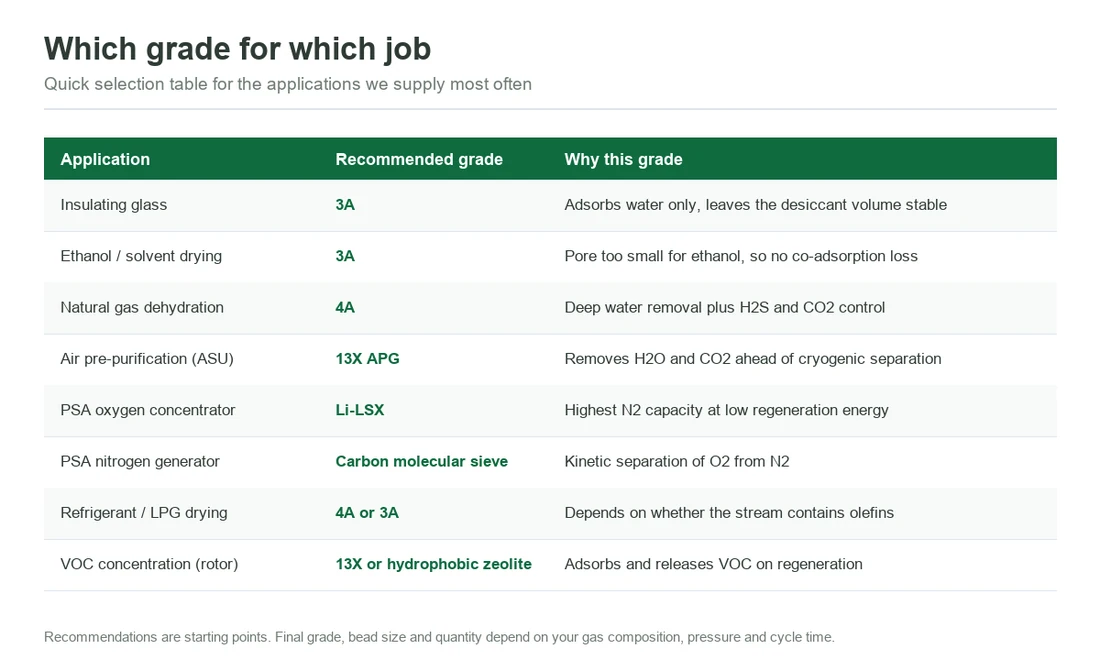
| If the duty is | Choose | Because |
|---|---|---|
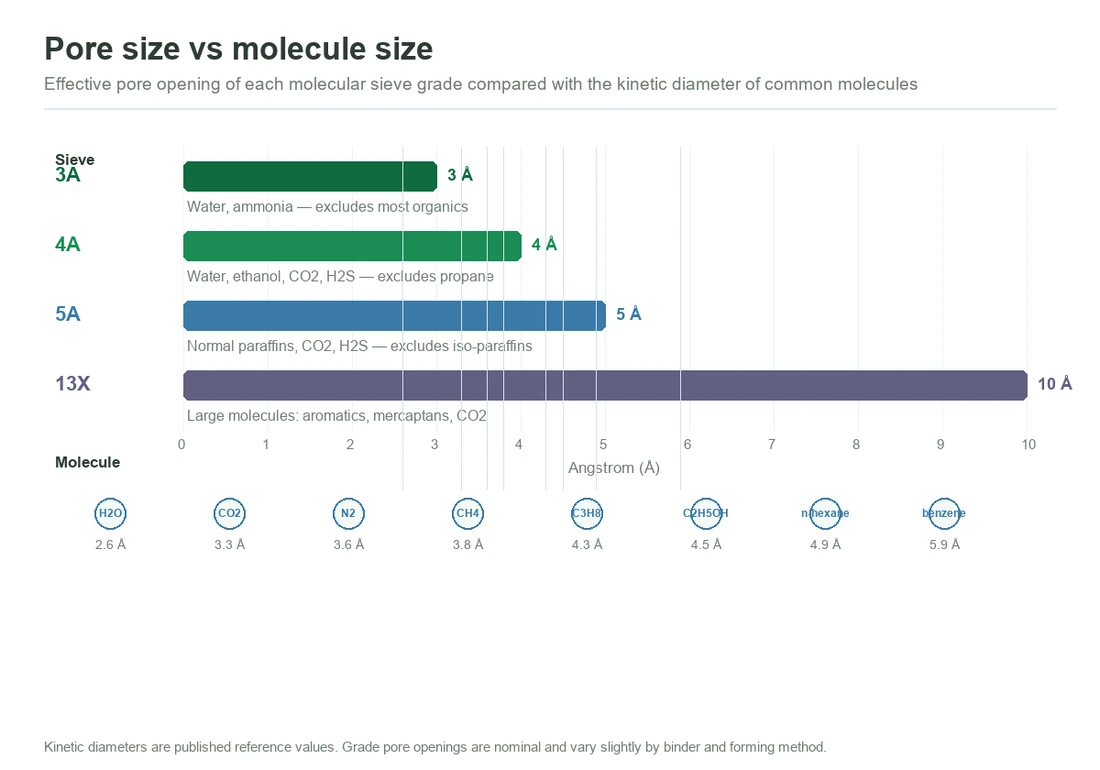
| Drying unsaturated hydrocarbons, cracked gas, ethylene, propylene, LPG, refrigerants | 3A | The 3 Å opening takes water and excludes the molecule you are drying |
| General gas and liquid drying, natural gas, sealed packaging | 4A | Larger opening and higher capacity where co-adsorption does not matter |
| Separating normal from iso-paraffins; PSA oxygen or hydrogen purification | 5A | 5 Å admits normal paraffins and excludes the branched ones |
| Air separation feed clean-up: water and CO2 together | 13X / 13X APG | 10 Å takes both in one bed; APG is made for the duty |
| VPSA or PSA oxygen, medical oxygen concentrators | Li-LSX | Highest nitrogen capacity per unit bed volume |
| PSA nitrogen generation | Carbon molecular sieve | Separates by rate, so short cycles produce nitrogen without a cryogenic plant |
| Moisture inside a sealed insulating glass unit | 3A | 4A would co-adsorb nitrogen from the sealed cavity and deflect the glass |
Reading a data sheet
| Number | What it tells you | What it does not tell you |
|---|---|---|
| Static water adsorption | How much water the sieve holds at equilibrium under the stated conditions | Working capacity at your conditions — always lower than the equilibrium figure |
| Bulk density | What the bed weighs, so what the vessel has to carry | Anything about performance |
| Crushing strength | Whether the beads survive loading and pressure cycling | Resistance to attrition in motion — that is a separate test |
| Attrition | How much dust is generated in handling and cycling | What happens after thousands of regenerations |
| Loss on ignition | How much water and volatile material is still in the pores | Whether the sieve was packed dry — check moisture as packed as well |
| Size range | Pressure drop and how evenly the bed packs | Whether fines were removed — ask about de-dusting |
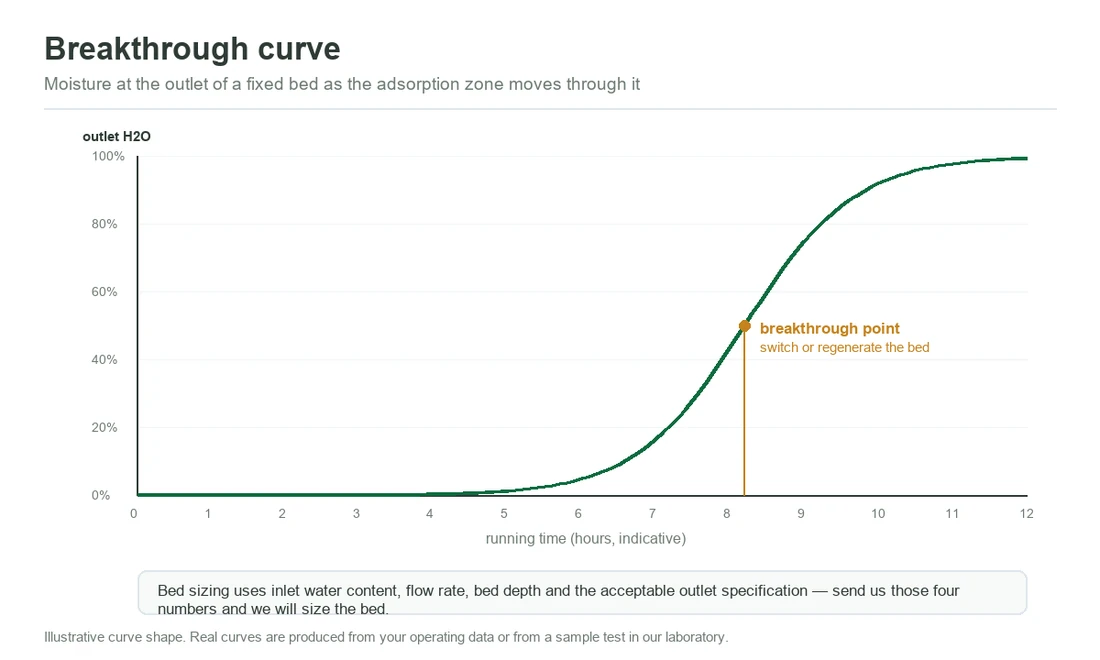
Equilibrium capacity is measured under laboratory conditions. Working capacity in a real bed is set by the regeneration temperature, the cycle time and how completely the bed is regenerated — it is always lower, and that is the number the design should use.
Regeneration
Thermal swing
Typically 200–300 °C for molecular sieve; confirm the window for your grade. A dry purge gas at 0.3–0.5 kg/cm2 for 3–4 hours, with the outlet reaching 110–180 °C, then cool.
What damages a bed
Regenerating too hot, regenerating with a wet purge gas, and cooling with gas that still carries water — all three leave capacity on the table permanently.
Organic fouling
Heavy organics coke in the pores. Strip with steam before the thermal step, or the bed loses capacity that no amount of heating brings back.
Pressure swing
No heat: the bed is regenerated by depressurisation and a purge. This is how PSA nitrogen and VPSA oxygen plants run, and why cycle time is a design variable.
When to replace
When working capacity no longer reaches the outlet specification within the cycle, or when pressure drop rises from fines — not on a fixed calendar.
Storage
Keep sealed, off the floor, out of humid air. Activated sieve picks up moisture within hours once the liner is opened.
Send us the duty
We will work it through with you
Stream composition, pressure, temperature, flow, target outlet, cycle time and regeneration method are enough for us to recommend a grade, size the bed and quote. If a vessel already exists, send the drawing and we will check whether an existing grade can be matched.
In this section
- Molecular sieve FAQ — grades, sizes, packing, documents, lead time and payment
- Downloads — TDS, SDS and what ships with every order
- Documents & compliance — what we issue and what we do not claim
- Custom & OEM — what can be varied for your order
- Regeneration & service life — temperatures, purge steps and when to replace the bed
Selection help, free of charge
Email sales@zeolitemolecularsieve.com — a recommendation costs you nothing whether or not you buy from us.
Market and buying guides
Published price indicators, cost structure, demand trends and import practice — written for buyers specifying molecular sieve.
- Molecular Sieve Price 2026: What Buyers Should Budget
- What Sets the Cost of Molecular Sieve
- Molecular Sieve Demand in 2026 by Application
- Importing Molecular Sieve from China: A Buyer’s Checklist
- Molecular Sieve Technology in 2026
Decision guides for specifying a bed
How to choose between desiccants, pick a bead size, classify the goods for customs, diagnose an underperforming bed, and spec a biogas train.
- Molecular Sieve vs Activated Alumina vs Silica Gel
- Molecular Sieve Bead Size: 1.6, 3.2 or 4.8 mm?
- Molecular Sieve HS Code: 2842.10, Not 3824.99
- Why Molecular Sieve Loses Capacity: Five Failure Modes
- Molecular Sieve for Biogas Upgrading
Process and operations guides
Ethanol dehydration, nitrogen generation, bed sizing, regeneration practice and warehouse handling.
- 3A Molecular Sieve for Ethanol Dehydration
- Carbon Molecular Sieve for PSA Nitrogen Generation
- How to Size a Molecular Sieve Bed: Five Steps
- Molecular Sieve Regeneration: Temperature by Type
- Molecular Sieve Storage and Shelf Life
Product-duty guides
Oxygen generation, gas dehydration, insulating glass, air pre-purification and compressed-air drying – grade selection for each duty.
- Li-LSX Molecular Sieve for PSA Oxygen
- Natural Gas Dehydration: 3A, 4A or 13X?
- 3A Molecular Sieve in Insulating Glass Spacers
- 13X APG in Air Pre-Purification
- 4A Molecular Sieve in Compressed-Air Dryers
Bulk supply and procurement guides
Order mechanics for industrial buyers: minimum quantities, packing, FCA and EXW terms, the document pack, and replacement planning for PSA nitrogen generators.