



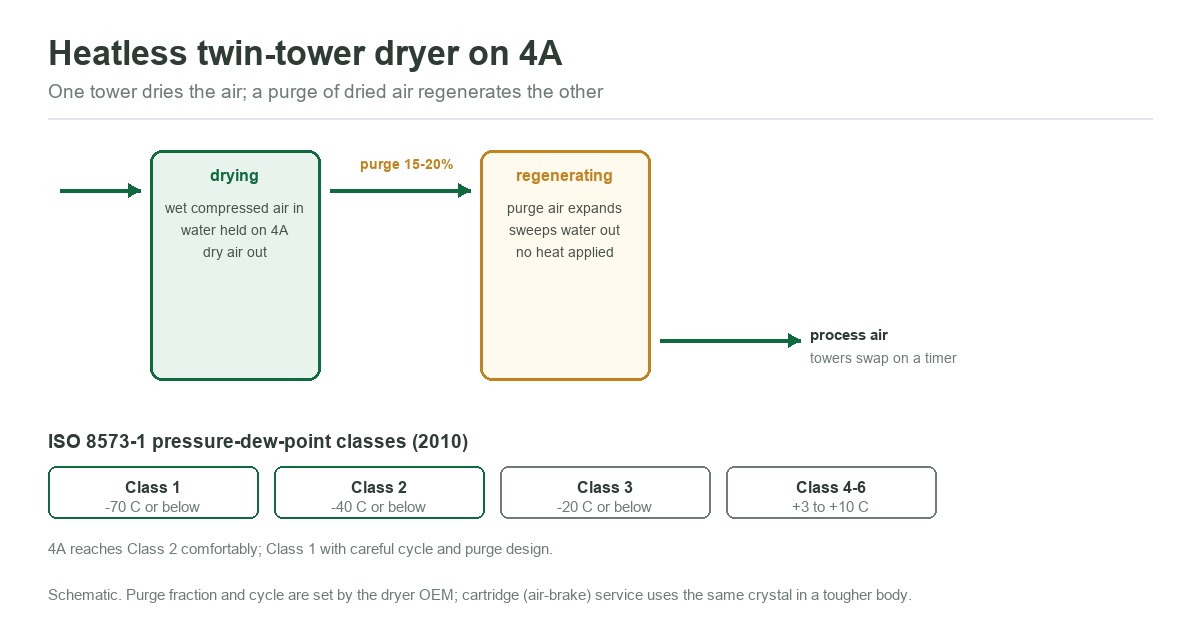
Compressed air is the third or fourth utility in most plants, and it is wet: every compression cycle pulls atmospheric moisture through the machine. Where the process cannot tolerate that water — instrumentation, spraying, electronics, cold lines, food contact — the standard answer is a twin-tower dryer running on 4A molecular sieve.
Dew points and what the classes ask
The compressed-air world grades dryness by ISO 8573-1 pressure-dew-point classes. Matching the class to the process is the first step — drying a whole factory to Class 1 is expensive air.
| ISO 8573-1 class (2010) | Pressure dew point | Typical use |
|---|---|---|
| Class 1 | ≤ −70 °C | Lab air, sensitive electronics, cryogenic-adjacent duties |
| Class 2 | ≤ −40 °C | Instrument air, general process air — the common target |
| Class 3 | ≤ −20 °C | Workshop and general plant air |
| Class 4–6 | +3 to +10 °C | Bulk utilities where condensation is acceptable |
4A reaches Class 2 comfortably in a properly designed heatless dryer and Class 1 with attention to cycle and purge. Below roughly −70 °C, further gains cost more than most processes can justify.
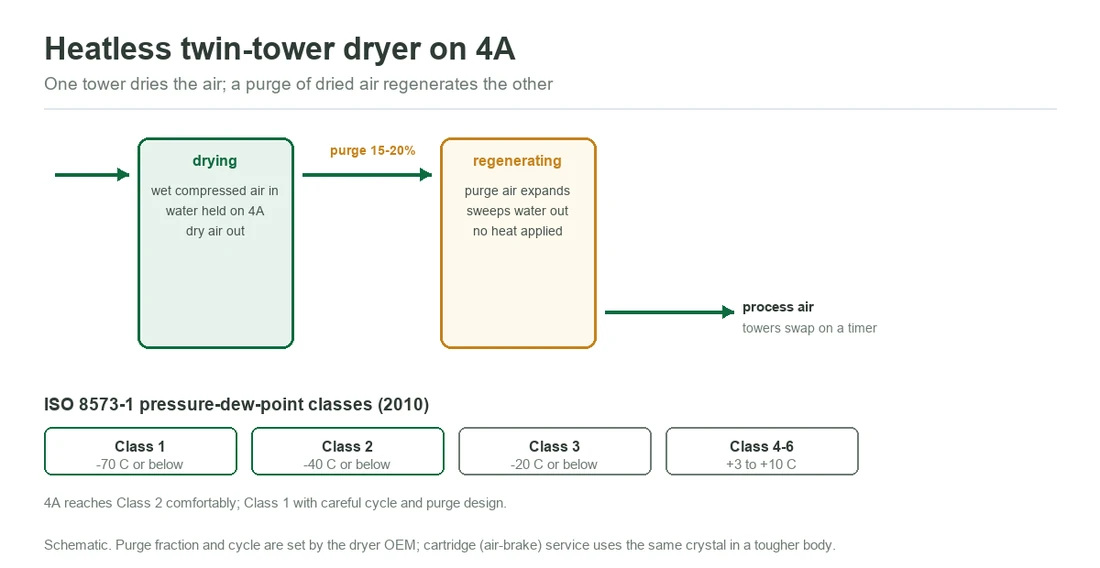
The heatless cycle, in one paragraph
Two towers alternate: while tower one dries the air stream, a fraction of that dried air — the purge, commonly in the 15–20% band for classic heatless designs — expands to atmosphere and sweeps the spent tower, desorbing its water without heat. Towers swap on a timer, typically every several minutes. Every design parameter — cycle length, purge fraction, bed depth — trades energy against dew point, and the adsorbent is where the trade lands.
What kills 4A dryer beds
- Oil aerosol from the compressor. Oil coats the crystal surface and capacity leaves permanently. A coalescing filter upstream of the dryer is part of the adsorbent specification, not an optional extra — and oil-free compressors change the maintenance story entirely.
- Liquid water slugs. After-cooler and knock-out failures deliver water faster than the bed can distribute it; beads fracture, dust migrates downstream.
- Ambient dust and corrosion products carried in from old pipework — the reason dryers are usually specified with inlet filtration.
- Tired regeneration. A purge valve leaking closed regenerates nothing; the bed ratchets wet within days.
The cartridge side: air-brake dryers
Vehicles dry their brake air on 4A too, in sealed cartridges downstream of the compressor. The duty is brutal — pressure and temperature cycling, vibration, oil-laden air from a shared compressor — so cartridge-grade 4A leans on crush strength, low dust and controlled bead sizing more than on lab capacity. Fleet buyers replace cartridges on schedule; cartridge makers buy the beads by the ton and live with whatever attrition they accept. The COA is the contract.
Spec lines for dryer-grade 4A
- Dynamic water capacity at dryer-like conditions — the engineering number, stated per batch.
- Crush strength, both single-bead and bulk, for cartridge and deep-bed service.
- Dust and attrition — what ends up on your valve seats otherwise.
- Bead fractions — commonly 1.6–3.2 mm for towers and finer fractions for cartridges.
- Packed water content — dry on arrival, COA in the box.
Figures marked as typical ranges are indicative values compiled from published supplier datasheets and standard adsorption-engineering references. They describe the class of material, not our specification and not a performance guarantee for your unit. Bed design must be confirmed against your own flow, pressure, temperature and dew-point target.
Specifying 4A for compressed-air drying? We will match the grade to the machine:
- Dryer type and target dew-point class: heatless tower, heated, or cartridge
- Air flow, operating pressure and purge capability
- Compressor type — oil-lubricated or oil-free — and inlet filtration
- For cartridges: the housing spec and the attrition limit you test to
Send those to our technical desk and you get a grade recommendation, a datasheet for the exact grade proposed, and a quotation with packaging and Incoterms stated — not a generic price list.
Related pages on this site
- 4A molecular sieve product page
- Industrial drying application page
- Refrigeration and air-conditioning drying
- Why molecular sieve loses capacity
Frequently asked questions
Which dew point does 4A reach in a heatless dryer?
Class 2 (−40 °C pressure dew point) comfortably in a proper design,and Class 1 (−70 °C) with careful cycle and purge design. Below that,cost rises faster than benefit for most duties.
Is 4A or activated alumina better for compressed air?
Alumina dries bulk water cheaply to moderate dew points; 4A reaches the deeper dew points. Many designs layer them — alumina for bulk water at the inlet,4A to finish — the same composite logic used in air-separation purifiers.
Why do dryer beds die early?
Usually oil aerosol from a lubricated compressor, liquid-water slugs from after-cooler failures, or a failed purge valve that stops regeneration. The zeolite rarely fails on its own.
How much purge does a heatless dryer need?
Classic heatless designs run of the order of 15–20% of dried air as purge; heated and heat-of-compression designs cut that sharply at the cost of hardware. The purge fraction is the main energy lever.
Is the same 4A used in air-brake cartridges?
Same crystal, tougher body: cartridge-grade 4A emphasises crush strength, low dust and bead-size control because brake-air service cycles pressure,temperature and vibration continuously.