



Molecular sieve demand is not growing evenly. Traditional drying — the mature application that built the industry — is expanding slowly, while gas separation, carbon capture and a cluster of newer uses are growing several times faster. If you buy on a multi-year contract, that split matters: the grades under pressure in 2030 are not the ones under pressure today.
The headline numbers
| Metric | 2026 | Note |
|---|---|---|
| Global molecular sieve adsorbent demand | about 1.426 million tonnes | up about 6.8% year on year |
| Global zeolite molecular sieve market value | about USD 4.8 billion | projected to reach about USD 7.6 billion by 2033, about 6.7% CAGR |
| China market value | about USD 1.1 billion | projected to approach USD 1.8 billion by 2033 |
| United States market value | about USD 820 million | growing about 5.8% a year |
| Germany market value | about USD 240 million | replacement and service-led |
| Japan market value | about USD 210 million | quality-led, about 4.2% a year |
| China domestic market, local reporting | about RMB 48 billion | up about 9.5%; capacity utilisation around 82% |
China is the largest volume market and one of the fastest growing. Asia-Pacific was reported to account for just over half of the global demand increment in 2026, driven by refinery upgrading, ethylene complexes and industrial gas infrastructure.
Growth by grade type
| Type | 2026 position | Growth |
|---|---|---|
| A type (3A, 4A, 5A) | about 614,000 tonnes, about 43% of demand | slowing to about 4.9% |
| X and Y type (13X, 13X APG, Li-LSX) | driven by xylene separation and PSA oxygen | combined about 8.7% |
| ZSM-5 and high-silica speciality | small base | about 15.2% |
The pattern is clear: the commodity drying grades are maturing, and the growth is in the higher-performance structures. For a buyer, this argues for qualifying a second source on any X-type or speciality grade now rather than during the next capacity squeeze.
Growth by application
| Application group | 2026 demand | Growth |
|---|---|---|
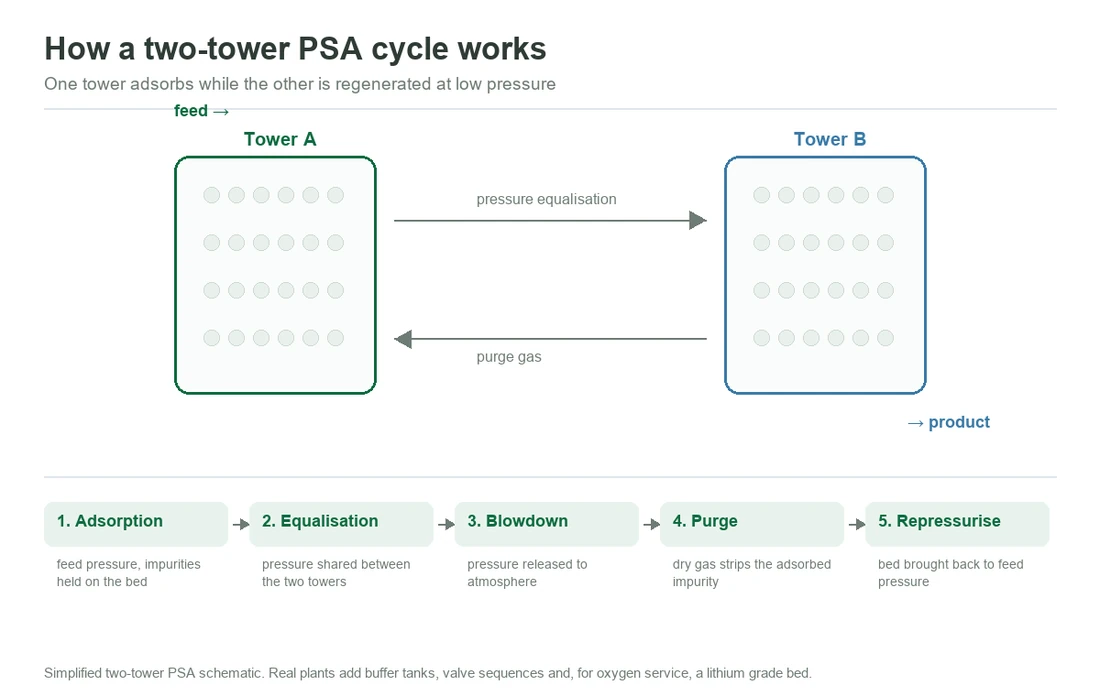
| Gas separation and purification (PSA oxygen, nitrogen, hydrogen, CO2 capture) | about 273,000 tonnes | about 16.7% |
| Gas separation and purification overall, wider definition | about 782,000 tonnes | largest single downstream segment |
| Liquid separation and drying (including fuel ethanol dehydration) | about 446,000 tonnes | about 5.8% |
| Environmental (fluorinated and sulphurous off-gas treatment, VOCs) | about 198,000 tonnes | about 11.3% CAGR expected over five years |
| Emerging (insulating glass, refrigeration and air-conditioning drying, battery electrolyte drying) | about 159,000 tonnes | about 13.4% |
The three named terminal drivers behind the 2026 figures were deep natural gas dehydration, olefin separation and volatile organic compound control. Within gas separation, PSA oxygen, nitrogen and hydrogen purification were reported at roughly 31.5%, 28.7% and 17.4% of the segment respectively.
Supply and trade
- Global effective capacity was reported at about 1.263 million tonnes in 2026, with China accounting for about 58.2%.
- High-end products — high silica-to-alumina ratio, nuclear grade and medical grade — remain led by European, US and Japanese producers.
- Global trade was estimated at about 415,000 tonnes, with China the largest exporter at about 197,000 tonnes, flowing mainly to Southeast Asia and the Middle East.
- The European Union was the largest net importing region at about 89,000 tonnes, and its carbon border adjustment mechanism was reported to be adding roughly 3.8% to the price of higher-end non-EU material.
- China’s molecular sieve exports were forecast to grow about 12% in 2026.
For European buyers, the CBAM effect is a real and specific cost line on premium grades. For buyers elsewhere, the more relevant point is that China’s export volume keeps rising while its share of high-end capacity stays limited — so the grades worth qualifying early are the speciality ones.
What this means for your 2027 planning
- 3A, 4A and 5A: ample supply, mature demand. Buy on service and consistency, not on availability.
- 13X and 13X APG: growing faster than the market. Qualify a second source before you need it.
- Li-LSX and carbon molecular sieve: exposed to lithium pricing and to oxygen and nitrogen equipment build-out respectively. Longer price holds are worth negotiating.
- Speciality and high-silica grades: the tightest segment and the one where lead times stretch first.
We run 6,000 tonnes a year across seven grades. See the product range, the applications we supply into — natural gas dehydration, oxygen generation, air separation, industrial drying, insulating glass, VOC emission control and refrigeration and air-conditioning drying.
Related reading
- Molecular Sieve Price 2026: What Buyers Should Budget
- What Sets the Cost of Molecular Sieve
- Importing Molecular Sieve from China: A Buyer’s Checklist
- Molecular Sieve Technology in 2026
Frequently asked questions
Which molecular sieve applications are growing fastest in 2026?
Industrial gas separation led growth at about 16.7%, covering PSA oxygen, nitrogen, hydrogen purification and CO2 capture. Emerging applications such as insulating glass drying, refrigeration and air-conditioning drying and battery electrolyte drying grew about 13.4%. Environmental uses including VOC and off-gas treatment were forecast at about 11.3% CAGR over five years.
Is demand for 3A and 4A molecular sieve still growing?
Yes, but more slowly. A-type grades were about 614,000 tonnes in 2026, roughly 43% of total demand, with growth slowing to about 4.9%. X and Y types grew about 8.7% and ZSM-5 and high-silica speciality grades about 15.2%.
How much molecular sieve capacity does China have?
Global effective capacity was reported at about 1.263 million tonnes in 2026, with China at about 58.2% of it. China was also the largest exporter at about 197,000 tonnes of an estimated 415,000 tonnes of global trade. High-end grades remain led by European, US and Japanese producers.
Does the EU carbon border mechanism affect molecular sieve prices?
Yes, on the higher-end grades. The EU was the largest net importing region at about 89,000 tonnes in 2026, and the carbon border adjustment mechanism was reported to add roughly 3.8% to the price of higher-end non-EU material.
Should I qualify a second supplier?
For commodity A-type grades, supply is ample and the decision is usually about consistency and service. For X-type, Li-LSX, carbon and high-silica speciality grades, demand is growing faster than the market average and qualifying a second source early is the safer position.
Prices and market figures in this article are taken from publicly published third-party sources and are dated where known. They are industry reference points, not our quotation. We do not publish a price list — every quotation is built from grade, bead size, quantity, packaging and Incoterms. Ask us for a current quote for your specification.