



Short answer for buyers in a hurry: we are a molecular sieve manufacturer supplying industrial quantities direct from our plant in Zhengzhou, Henan — 6,000 tonnes a year, seven grades, minimum order 1,000 kg per grade and bead size, 10–15 working days for standard grades, shipped FCA, EXW, FOB, CFR, CIF or DAP through Qingdao, Tianjin or Shanghai. Every batch leaves with its own certificate of analysis and a 16-section safety data sheet.
This page is written for the person who has to place the order: a procurement engineer, an OEM building PSA units, or a distributor restocking. It covers the commercial mechanics — minimum quantities, packing, delivery terms, documents — rather than adsorption chemistry. Grade selection is a separate conversation, covered in our grade comparison and bed sizing guides.
What “factory direct” changes, and what it does not
A trading company buys from a plant and resells. That model works until something goes wrong with a batch, at which point the answer depends on how much the intermediary actually controls. Buying direct from the producer changes three practical things:
- The specification is negotiable before production, not after. Bead size, packing and marking are agreed in writing and the batch is made to that agreement.
- The test data belongs to your lot. The COA carries the measured values of the batch you receive — crush strength, water adsorption, bulk density, loss on ignition — not a catalogue average.
- Someone who can answer a technical question. Questions about regeneration temperature, dew point or bed contamination reach the people who run the line.
What it does not change: you still need a clear specification, you still pay for freight, and a factory will not invent a certification it does not hold. Our position on documents is set out on the documents and compliance page — anything we cannot evidence in writing, we do not print.
Minimum order quantity and how a bulk order is built
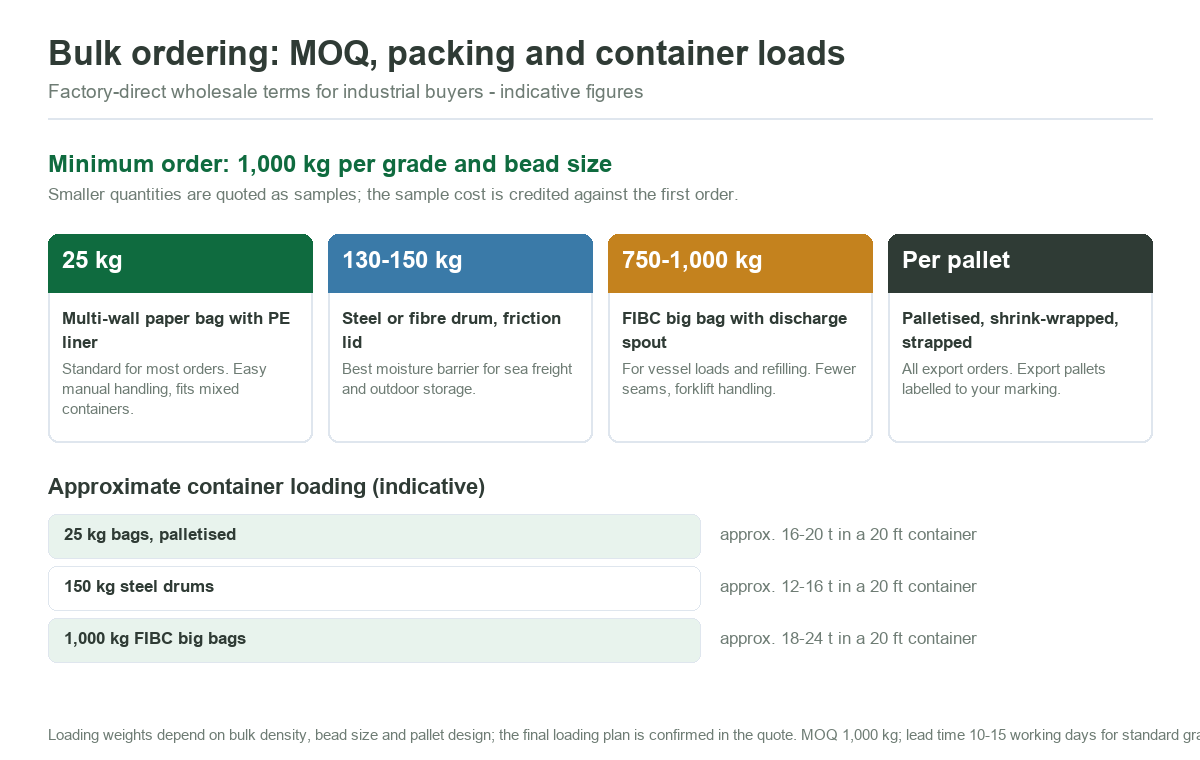
The minimum order is 1,000 kg per grade and per bead size. Below that we quote the quantity as a sample, and the sample cost is credited against your first production order — so testing a grade before committing a container costs you freight, not product. Above the minimum, orders are built from packing units rather than from a price break table: you choose the packing that suits your unloading and storage, and the quantity follows.
| Packing unit | Net weight | Typical use |
|---|---|---|
| Multi-wall paper bag with PE liner | 25 kg | Standard for most orders; fits mixed containers and manual handling |
| Steel or fibre drum, friction lid | 130–150 kg | Long storage, humid destinations, sea freight |
| FIBC big bag with discharge spout | 750–1,000 kg | Vessel loading, refilling, minimum seams |
| Palletised and shrink-wrapped | per pallet | All export orders; labelled to your marking |
Indicative container loads — 16–20 t of 25 kg bags palletised, 12–16 t of 150 kg drums, or 18–24 t of 1,000 kg big bags in a 20 ft container — depend on bulk density, bead size and pallet design, so the loading plan is confirmed with the quotation rather than assumed from a table.
Packing is part of the specification
Molecular sieve starts adsorbing the moment the seal is broken. A container that sits in a humid yard for three weeks before the vessel sails will pick up water through any seam that is not barrier-sealed — and the buyer discovers it as a dew point that will not come down, months later. Every unit we ship is sealed with a moisture barrier, palletised, stretch-wrapped and strapped, and the liner and moisture-indicator card are available on request so your receiving team can see the condition on arrival. Packing options and the documents that travel with each order are detailed on the packaging and shipping page.
FCA, EXW, FOB or CIF: choosing the delivery term
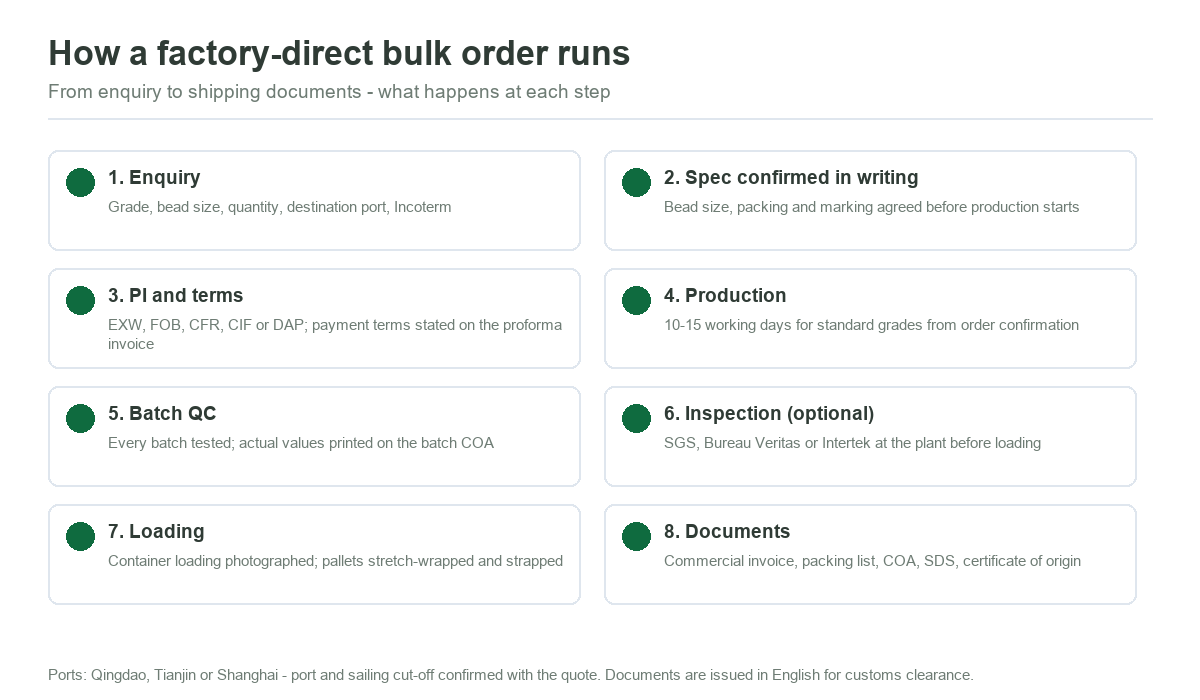
All five terms are available: EXW, FCA, FOB, CFR, CIF and DAP. The choice matters more than most buyers expect, because the Incoterm decides who is responsible for Chinese export clearance, and Chinese export clearance is not something a foreign buyer can perform without a local entity.
- FCA (Free Carrier) — we clear the goods for export and hand them to your forwarder at a named place, usually the container yard or our plant. This is the term we recommend for most first orders: you keep control of the freight, and the export declaration is handled by the party that is actually able to file it.
- EXW (Ex Works) — the goods are yours at our gate, with export clearance and loading on your account. It looks cheapest on a quotation and is usually the most expensive in practice, because a buyer without a Chinese entity has to appoint an agent to file the export declaration. Choose it only if you already have that arrangement.
- FOB — we deliver to the vessel at Qingdao, Tianjin or Shanghai and clear export; you pay ocean freight and insurance.
- CFR / CIF — we arrange and pay the ocean freight, and under CIF the insurance to the destination port.
- DAP — we deliver to your named place, with import duty and clearance on your side.
Ports: Qingdao, Tianjin or Shanghai, confirmed with the quote along with the sailing cut-off. Documents are issued in English for customs clearance.
The document pack that travels with a bulk order
For industrial buyers the paperwork is not an afterthought — an SDS in the wrong format can stop a container at the destination, and an importer without a COA cannot release the material to production. Every shipment includes the commercial invoice, packing list, batch certificate of analysis and a safety data sheet written in the 16-section EU 2020/878 format, which is also accepted by most other jurisdictions. A certificate of origin and an ISPM 15 treatment declaration for timber pallets are issued on request; third-party pre-shipment inspection by SGS, Bureau Veritas or Intertek can be arranged at your cost.
Two things we deliberately do not do: we do not quote a REACH registration number we cannot show, and we do not put a certificate on this website without its number, issuing body and validity. If your import requires a regulatory status statement, tell us the tonnage band and we confirm in writing what the plant can support before you commit. Customs classification is covered separately in our HS code guide.
Seven lines to put in your enquiry
An enquiry that contains these seven lines gets a firm price and a date the same day; one that says “price for molecular sieve” gets a question back. The specification side is covered in detail in our bead size guide, but commercially these are the lines that matter:
- Grade and application — 3A, 4A, 5A, 13X, 13X APG, Li-LSX or carbon molecular sieve, and the duty it serves (gas drying, air pre-purification, oxygen, nitrogen).
- Bead or pellet size — for example 1.6–2.5 mm or 3.0–5.0 mm beads, 1/16″ or 1/8″ pellets.
- Quantity, per grade and per size, with the packing format you want.
- Destination port and the Incoterm you intend to buy on.
- Target specification — the COA lines you will check on arrival: static water adsorption, crush strength, bulk density, attrition, loss on ignition.
- Marking and labelling — private label, lot numbering, pallet labels.
- Timing — when the material has to be on the water, which sets whether we build the order into the next standard run or schedule a dedicated one.
Industrial duties we supply in bulk
The same commercial terms apply across the range; what changes is the grade and the specification emphasis. Bulk shipments most often go to these duties:
- PSA gas dehydration — 3A and 4A for natural gas, ethanol and solvent drying, where water capacity and regeneration stability drive the economics.
- Nitrogen generation — carbon molecular sieve for PSA nitrogen generators, sized by bed volume; the replacement-planning method is set out in our nitrogen generator supply guide.
- Oxygen generation — Li-LSX for medical and industrial PSA oxygen plants, with 13X or activated alumina as the guard layer.
- Air pre-purification and compressed air drying — 13X APG and 4A downstream of refrigerated or desiccant dryers.
- Insulating glass — 3A in spacer desiccant, where the sieve must adsorb water without taking up the fill gas.
Who you are buying from
Production runs at our plant, Pingxiang Jianghua Environmental Packing Co., Ltd. in Pingxiang, Jiangxi — a chemical packing plant that is a qualified member of Sinopec’s “Three Agents” cooperation network, an approved supplier member of ChemChina Group, certified to ISO 9001 and operating its own testing laboratory. It has supplied Sinopec, PetroChina, CNOOC and ChemChina subsidiaries for years and exports to the United States, Europe and Asia. The full credential list, and how we evidence it, is on the documents and compliance page. You are welcome to visit the plant, or to audit it by video call before placing a first order.
Frequently asked questions
What is the minimum order quantity for molecular sieve?
The MOQ is 1,000 kg per grade and per bead size. Quantities below that are quoted as samples, and the sample cost is credited against the first production order.
Are you a manufacturer or a trading company?
We are a manufacturer: research, production and sales are handled by one company, with 6,000 tonnes of annual capacity at our plant in Zhengzhou, Henan. Buyers are welcome to visit the plant or audit it by video call.
Do you supply molecular sieve in bulk for container shipment?
Yes. Bulk orders ship in 25 kg multi-wall bags with PE liner, 130–150 kg steel or fibre drums, or 750–1,000 kg FIBC big bags, palletised and stretch-wrapped. Indicative 20 ft container loads run from 12 t for drums to 24 t for big bags, depending on bulk density and pallet design.
What is the difference between FCA and EXW for a Chinese supplier?
Under FCA the supplier clears the goods for export and hands them to your forwarder at a named place; under EXW the buyer is responsible for Chinese export clearance. Because a foreign buyer usually cannot file a Chinese export declaration without a local agent, FCA is normally the cheaper and simpler term in practice.
Which Incoterms and ports do you work with?
EXW, FCA, FOB, CFR, CIF and DAP, loaded through Qingdao, Tianjin or Shanghai. The port and the sailing cut-off are confirmed with the quotation.
What documents come with a bulk shipment?
Commercial invoice, packing list, batch certificate of analysis with the measured values of the shipped lot, and a safety data sheet in the 16-section EU 2020/878 format. Certificate of origin and ISPM 15 declaration on request; third-party inspection by SGS, Bureau Veritas or Intertek can be arranged at the buyer’s cost.
How long does a bulk order take?
10–15 working days for standard grades from order confirmation. Bespoke bead sizes, private-label packing and dedicated production runs add time, which is stated in the quotation rather than discovered later.
Can you pack under our own brand?
Yes. Private-label bags and drums, lot numbering and pallet marking are confirmed in writing before production starts. Custom packing and custom grades are handled through our custom and OEM service.
Do you supply carbon molecular sieve for nitrogen generators in bulk?
Yes. Carbon molecular sieve is produced on a dedicated line and supplied for PSA nitrogen generators, typically in 1,000 kg big bags or 25 kg bags. Replacement quantities are sized from the adsorber bed volume, using typical CMS bulk density of 630–700 kg/m³.
Can we test a grade before committing to a container?
Yes — a 0.5–1 kg sample per grade and bead size, taken from the same production line as bulk orders rather than a separate laboratory batch. The sample cost is credited against the first order.
How is the price for a bulk order set?
Price is quoted per grade, size, packing and Incoterm, against a stated quantity and destination. Our cost breakdown is explained in the price guide; the binding figure is always the one on the quotation, not a figure on a web page.
Send these six lines and we return a firm price, a loading plan and a date — usually the same working day. Request a bulk quotation.
- Grade and application
- Bead or pellet size
- Quantity per grade and packing format
- Destination port and preferred Incoterm (FCA, EXW, FOB or CIF)
- The COA lines you will check on arrival
- Required delivery date
Send those to our technical desk and you get a grade recommendation, a datasheet for the exact grade proposed, and a quotation with packaging and Incoterms stated — not a generic price list.
Figures marked as typical ranges are indicative values compiled from published supplier datasheets and standard adsorption-engineering references. They describe the class of material, not our specification and not a performance guarantee for your unit. Bed design must be confirmed against your own flow, pressure, temperature and dew-point target.