



Classification is the least interesting part of a purchase and the most expensive thing to get wrong. A molecular sieve declared under the wrong heading can clear at a different duty rate, attract a different set of trade measures, and in the worst case sit in a customs hold while an officer asks for a written classification decision.
This is what we tell buyers who ask us to put a code on the invoice, and what our own export declarations use.
The correct heading for synthetic zeolite
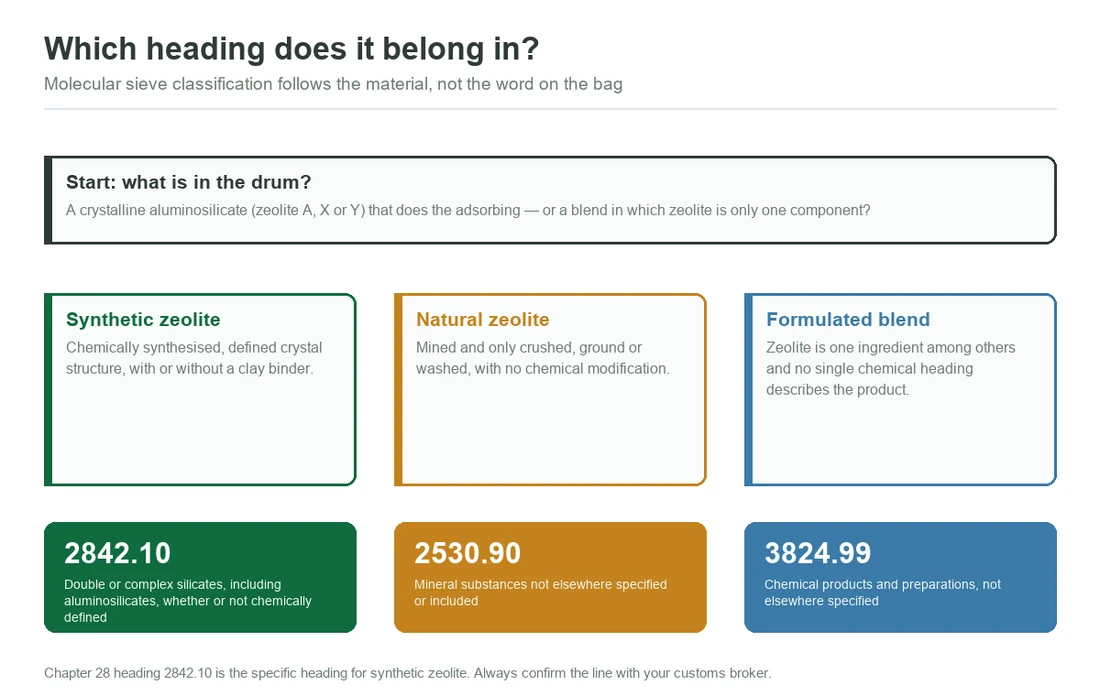
Synthetic zeolite — the crystalline aluminosilicate that molecular sieve is made of — is classified under HS 2842.10: “double or complex silicates, including aluminosilicates, whether or not chemically defined”. The heading sits in Chapter 28, inorganic chemicals, because the material is a defined chemical structure rather than a preparation.
Chinese export declarations for molecular sieve are routinely filed under 2842.10.00, and that is the code our shipments use. In the US tariff schedule the line is HTSUS 2842.10.00.00, with a most-favoured-nation rate of 3.7%.
The codes it gets confused with
| Code | Description | When it is correct | Why it is used by mistake |
|---|---|---|---|
| 2842.10 | Double or complex silicates, including aluminosilicates | Synthetic zeolite molecular sieve, including clay-bound beads | — |
| 3824.99 | Chemical products and preparations, not elsewhere specified | Formulated blends where the zeolite is one component among others and no single heading applies | It is the default code many forwarders reach for when they do not recognise the product |
| 2530.90 | Mineral substances not elsewhere specified | Natural zeolite that has only been crushed, ground or washed | Buyers see the word “zeolite” and assume a mineral |
| 3802.10 | Activated carbon | Carbon molecular sieve is sometimes declared here | CMS is a carbon material but a distinct adsorbent; classification depends on form and function |
The 3824.99 habit is worth calling out because it looks harmless. It is a residual heading — the place customs rules send goods that have no better home. A molecular sieve does have a better home. Declaring it as a residual chemical preparation invites a reclassification, and a reclassification after the fact is a retroactive duty assessment plus penalties, not a conversation.
Why an importer should care about the difference
- The duty rate differs. In the US schedule, 2842.10.00.00 carries a 3.7% MFN rate; the 3824.99 lines are in a different range. On a 20 tonne shipment the difference is real money, in either direction.
- Trade measures attach to specific lines. Additional duties are imposed line by line, not by product family. Two headings that sound similar can carry different additional rates, and the line you file is the line that is charged.
- Documentation expectations differ. A Chapter 28 inorganic chemical is expected to have a composition statement and an MSDS that match the declaration. A residual preparation invites questions about what else is in the drum.
- Repeat shipments inherit the error. Once a code is in your broker’s system, it is copied forward. Buyers have discovered years of misdeclaration at audit.
We state the code on our commercial invoice and on the packing list, and we will sign a classification statement describing the product if your broker needs one. We do not tell you what your duty will be — that is your broker’s call, and it depends on origin rules and on measures that change more often than any supplier’s website is updated.
Documents an importer actually needs
| Document | Issued by | What it must show |
|---|---|---|
| Commercial invoice | Supplier | Grade, bead size, quantity, unit price, Incoterm, HS code, origin |
| Packing list | Supplier | Drum or bag count, net and gross weight, dimensions, pallet count |
| Bill of lading | Carrier | Consignee, port of discharge, container number, seal number |
| Certificate of origin | Chamber of commerce or authority | Origin criterion; required for any preferential rate claim |
| Technical datasheet | Supplier | Grade specification actually shipped, with test methods |
| Certificate of analysis | Supplier, per batch | Measured values for the batch, not a generic sheet |
| Safety data sheet | Supplier | Composition, hazards, transport classification, handling |
| Non-hazardous declaration | Supplier | Confirms the material is not dangerous goods for transport |
| ISPM 15 marking | Packaging supplier | Required on any solid wood pallet or crate |
The two that cause the most delays are the ones suppliers are least careful about: a datasheet that does not match the batch actually in the drum, and a certificate of analysis that is a template with the batch number filled in. If your customs officer or your own quality team asks for the batch record and it does not exist, the delay is on the supplier.
Declaration details that trip up first shipments
- Grade and bead size on the invoice. “Molecular sieve” alone is not a description. Write 4A, 3.2 mm, 25 kg moisture-barrier bags.
- Net weight versus gross. Drums add 15–20 kg each. A 20 tonne net order is not a 20 tonne gross container, and the difference decides whether you are over the limit.
- Moisture-barrier packaging. Say it explicitly. It affects how the goods are handled and it is part of what you are paying for.
- Country of origin, not country of dispatch. Goods consolidating in a free zone do not change origin.
- Incoterm with a named place. “CIF” alone is an incomplete term and will be queried.
A note on duty rates that change
Between 2025 and 2026 several jurisdictions added, removed or modified additional duties on chemical imports, sometimes with days of notice. Any tariff figure quoted in a blog post — including this one — is a snapshot. What we can tell you is the classification and the facts of the goods. What you should do is have your broker confirm the payable rate against the measures in force on the date of entry, in writing, before you sign the purchase order.
The US schedule line for 2842.10.00.00 carried a 3.7% general rate and a footnote pointing to an additional China-specific measure when we last checked the published schedule in October 2026. Treat that as a starting point for a conversation with your broker, not as your landed cost.
What we can provide with the shipment
If your broker needs documentation before the goods move, tell us at the quotation stage:
- HS code on the commercial invoice and packing list, stated consistently
- A signed classification statement describing composition and function
- Batch certificate of analysis matching the drums shipped
- Grade datasheet with test methods, not just headline numbers
- Safety data sheet and non-hazardous declaration for transport
- Photographs of packing, pallet marking and container loading on request
Send those to our technical desk and you get a grade recommendation, a datasheet for the exact grade proposed, and a quotation with packaging and Incoterms stated — not a generic price list.
Frequently asked questions
What is the HS code for molecular sieve?
Synthetic zeolite molecular sieve is classified under HS 2842.10 — double or complex silicates, including aluminosilicates whether or not chemically defined. Chinese export declarations for molecular sieve are routinely filed under 2842.10.00, and in the US schedule the line is HTSUS 2842.10.00.00.
Why do some suppliers declare molecular sieve under 3824.99?
Because 3824.99 is a residual heading that accepts goods with no more specific home, and forwarders reach for it when they do not recognise the product. A molecular sieve has a more specific heading, so using the residual one invites reclassification, retroactive duty and penalties.
Does the HS code change the duty I pay?
It can, because duty rates and additional trade measures are set line by line. The payable rate also depends on origin and on measures in force on the date of entry, so it must be confirmed by your customs broker rather than taken from a supplier’s website.
Is carbon molecular sieve classified the same way?
Not necessarily. CMS is a carbon-based adsorbent, and classification depends on its form and function rather than on the word ‘sieve’. Confirm the correct line with your broker and have the supplier state it consistently on the invoice.
Is molecular sieve dangerous goods for shipping?
Molecular sieve as supplied is not classified as dangerous goods for transport, and we issue a non-hazardous declaration with each shipment. It is a dust irritant in handling, so the safety data sheet still applies in the workplace.
Can you ship under my preferred Incoterm?
Yes. We quote FOB, CIF or DAP with the named port or place stated, and we will quote more than one option so you can see the freight component separately. EXW is possible but rarely the right choice for a first order.
How much fits in a container?
A 20 ft container typically takes around 20 tonnes net in 25 kg bags on pallets, and slightly more in bulk bags, subject to weight limits on the route. We confirm the exact figure with the quotation and never plan a load that exceeds the limit.
Related reading: importing from China: a buyer’s checklist, packaging and shipping, and documents and compliance.
Figures marked as typical ranges are indicative values compiled from published supplier datasheets and standard adsorption-engineering references. They describe the class of material, not our specification and not a performance guarantee for your unit. Bed design must be confirmed against your own flow, pressure, temperature and dew-point target.