



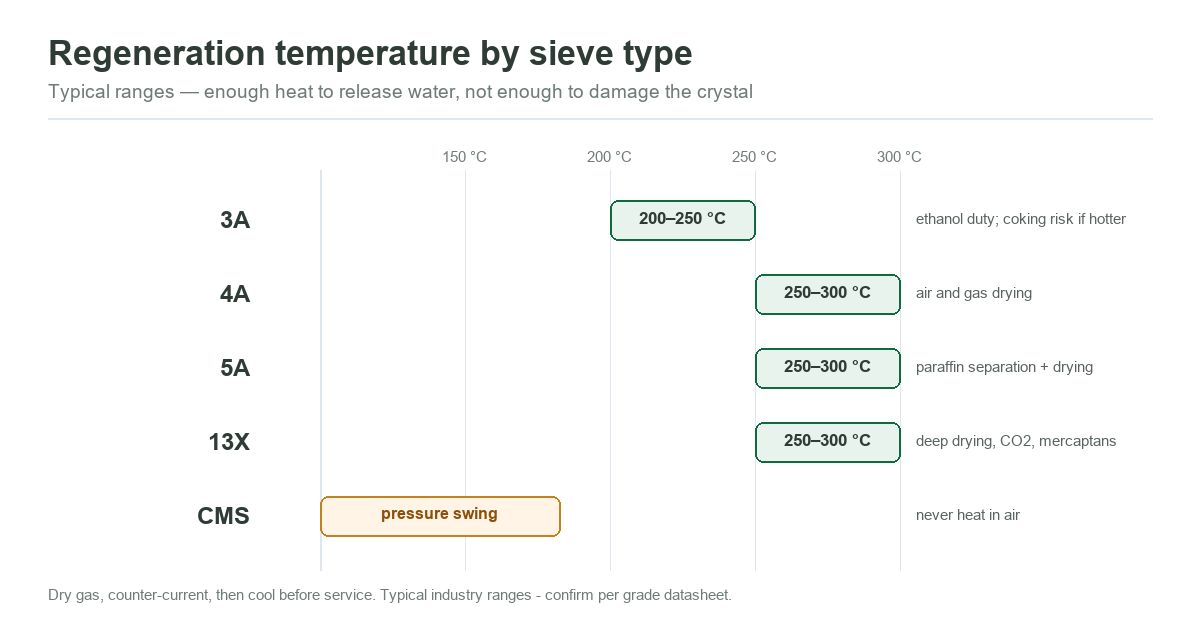
Regeneration is where sieve beds are quietly won or lost. Too cool, and every cycle starts with residual water in the bed — capacity you paid for is never on sale. Too hot, and you slowly cook the crystal or coke organic carryover onto it. The window for each type is set by how strongly its crystal holds water.
Typical regeneration windows
Ranges below are the industry-typical windows; the grade datasheet and your process chemistry set the exact point within them.
| Type | Typical window | Notes |
|---|---|---|
| 3A | 200–250 °C | Ethanol and cracked-gas duties; higher risks coking organic carryover |
| 4A | 250–300 °C | General air and gas drying |
| 5A | 250–300 °C | Drying plus n-paraffin separation duties |
| 13X | 250–300 °C | Deep drying, CO2 and mercaptan removal — holds water harder, needs the heat |
| CMS | no thermal step | Pressure-swing regeneration only; heating CMS in air oxidises it |
The pattern is intuitive: the larger the cation and the bigger the cavity (13X), the more strongly polarised water is held and the more heat it takes to drive it out. 3A’s potassium framework releases water more easily — which is one reason it suits the fast, tight cycles of ethanol plants.
Four rules that matter more than the number
- Dry gas only. Regenerating with wet gas is recycling the same water between beds. The regeneration stream must be drier than the product target — dry product gas or dry nitrogen.
- Counter-current flow. Heat enters against the adsorption direction so water exits through the freshest end of the bed, never deeper into it.
- Full cool-down. A hot bed reloaded with feed wastes capacity (hot beds hold less) and, in hydrocarbon or alcohol service, can drive unwanted reactions. Cool on dry gas before switching in.
- Watch the endpoint, not the clock. Regeneration is complete when the exiting gas stops releasing water — watched via dew point or condensate rate — not when a timer elapses.
Symptoms of under-regeneration
- Adsorption cycles that shorten steadily over weeks — the bed starts each cycle part-loaded.
- A dew point that creeps up at the end of each cycle before switch-over.
- Condensate rates during regeneration that never fall to the usual baseline.
All three are cheaper to fix at the regeneration valve than with a refill. If cycles are already short and the dew point is lost mid-cycle, the deactivation diagnosis guide on this site helps separate regeneration problems from genuine capacity loss.
Figures marked as typical ranges are indicative values compiled from published supplier datasheets and standard adsorption-engineering references. They describe the class of material, not our specification and not a performance guarantee for your unit. Bed design must be confirmed against your own flow, pressure, temperature and dew-point target.
Tell us how the bed is actually being run and we will help you fix regeneration before you buy tonnage:
- Sieve type in service and the duty it performs
- Current regeneration temperature, gas type and flow direction if known
- The symptoms you are seeing: cycle length, product dew point, condensate pattern
- Bed age and any feed events (liquid carryover, upsets, chemistry changes)
Send those to our technical desk and you get a grade recommendation, a datasheet for the exact grade proposed, and a quotation with packaging and Incoterms stated — not a generic price list.