



Most of what is written about molecular sieve technology is lab results presented as if they were production. This article separates the two: what had actually reached production share by 2026, what remains a research direction, and which of it changes what you should specify when you buy.
Synthesis: solvent-free and microwave-assisted routes
| Measure | 2025 | 2030 forecast |
|---|---|---|
| Share of production lines using solvent-free or microwave-assisted synthesis | about 9.6% | about 28.4% |
| Energy consumed per unit of product, new routes versus conventional | baseline | about 22% lower |
That is the number worth watching. Roughly one production line in ten was using a solvent-free or microwave-assisted route in 2025, and the forecast puts close to three in ten there by 2030, with about 22% lower unit energy. For a buyer the significance is not the synthesis method itself — it is that the method determines crystal size distribution, and crystal size determines how fast the bead adsorbs and how well it survives cycling. Two batches of the same nominal grade made by different routes can behave differently in the same bed.
Where the research is concentrated
- Low silica-to-alumina ratio synthesis. Cheaper routes to the structures that currently command a premium.
- Nano-crystal size control. Tighter control of crystal size to shorten the mass transfer zone and speed up cycling.
- Lower regeneration energy. The largest operating cost in most adsorption systems, and the one buyers feel most directly.
- Composite and modified materials. Hydrophobic sieve for VOC service, and modified structures aimed at CO2 capture and methane upgrading.
Patent activity tracks the same themes. Roughly 23,000 molecular sieve patents were granted worldwide over the five years to 2026, with Chinese applicants accounting for about 41.7% of them. Volume is not the same as value — the most-cited core patents remain concentrated elsewhere — but it does indicate where manufacturing capability is being built.
What has not changed
- Pore size still decides everything. No amount of process innovation lets a 3A adsorb a molecule that will not fit. Grade selection remains the first and most consequential decision.
- High-end grades remain concentrated. High silica-to-alumina ratio, nuclear grade and medical grade materials are still led by European, US and Japanese producers, even though China holds about 58.2% of global effective capacity.
- Regeneration energy is still the dominant operating cost. A material that regenerates at a lower temperature can be worth more than a material with a higher headline capacity.
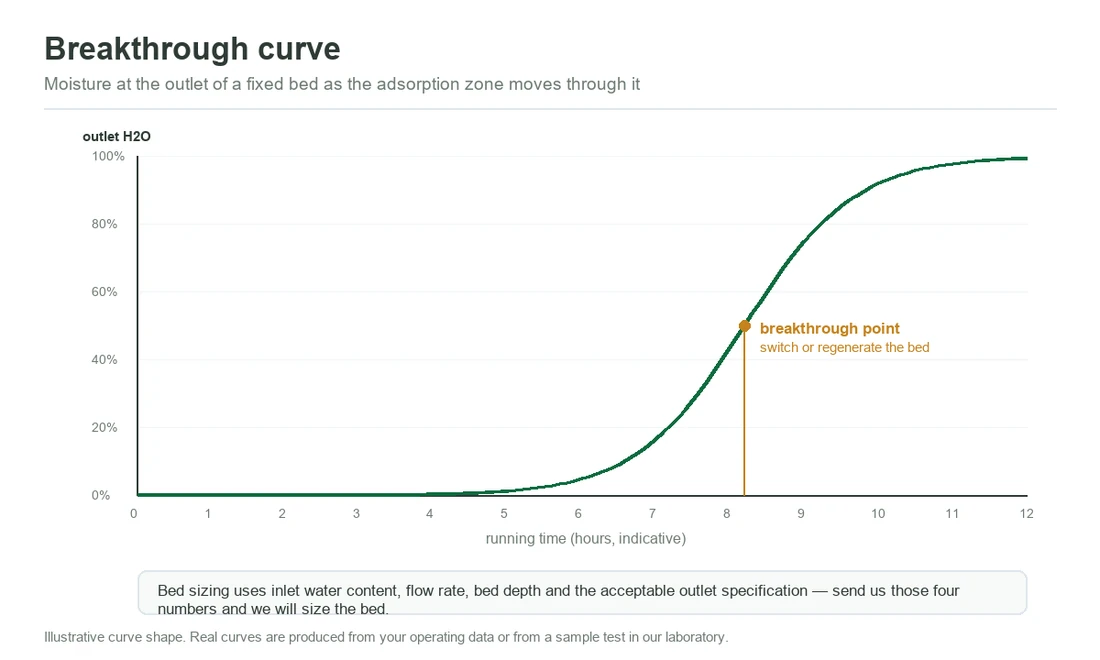
- Water is still the strongest adsorbate. In any stream containing water, assume the water wins and size the bed accordingly.
What to ask your supplier in 2027
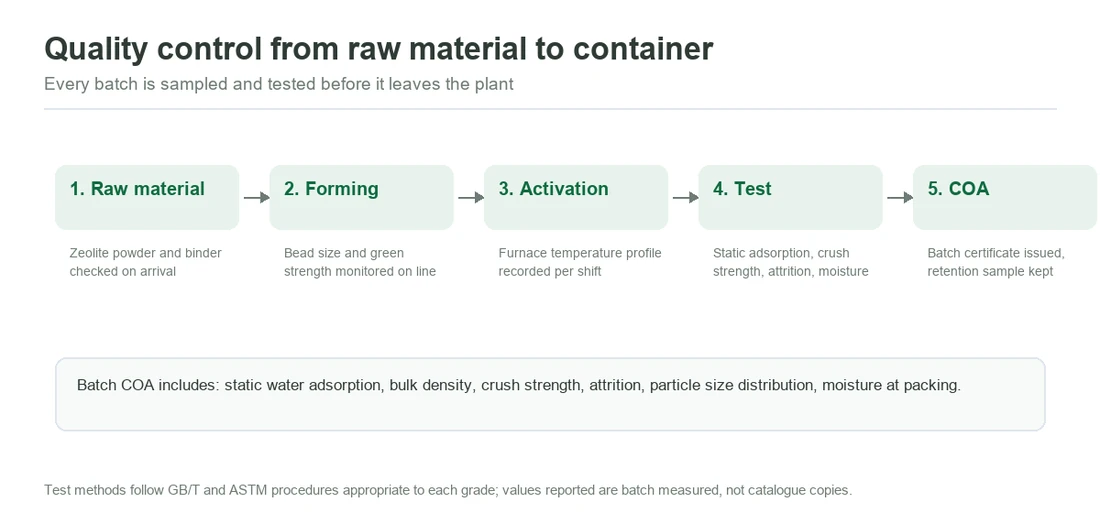
- Which synthesis route produces the grade you are buying, and is that route stable batch to batch?
- What is the crystal size distribution, not just the bead size?
- What regeneration temperature does the material actually need in service, and how much does capacity fade per hundred cycles?
- If the route changes, will you be told before the batch ships?
Those four questions separate a supplier who is manufacturing to a specification from one who is buying to a specification. See our manufacturing overview, testing regime, regeneration guide and grade comparison.
Related reading
- Molecular Sieve Price 2026: What Buyers Should Budget
- What Sets the Cost of Molecular Sieve
- Molecular Sieve Demand in 2026 by Application
- Importing Molecular Sieve from China: A Buyer’s Checklist
Frequently asked questions
What is new in molecular sieve manufacturing?
Solvent-free and microwave-assisted synthesis routes moved from pilot toward production, with their share of production lines forecast to rise from about 9.6% in 2025 to about 28.4% by 2030 and unit energy about 22% lower. Crystal size control and lower regeneration energy are the main research directions.
Does the manufacturing method change how the product performs?
Yes. The synthesis route determines crystal size distribution, which affects adsorption rate and how the material survives repeated cycling. Two batches of the same nominal grade made by different routes can behave differently in the same bed.
Which molecular sieve grades are still hard to source?
High silica-to-alumina ratio, nuclear grade and medical grade materials remain led by European, US and Japanese producers. China held about 58.2% of global effective capacity in 2026, but mostly outside these high-end segments.
What is the biggest operating cost in an adsorption system?
Regeneration energy. A material that regenerates at a lower temperature can be worth more than one with a higher headline capacity, which is why regeneration conditions should be part of the specification and not an afterthought.
Prices and market figures in this article are taken from publicly published third-party sources and are dated where known. They are industry reference points, not our quotation. We do not publish a price list — every quotation is built from grade, bead size, quantity, packaging and Incoterms. Ask us for a current quote for your specification.