


Quality Control — Molecular Sieve Testing & COA
What we test, and what you get in writing
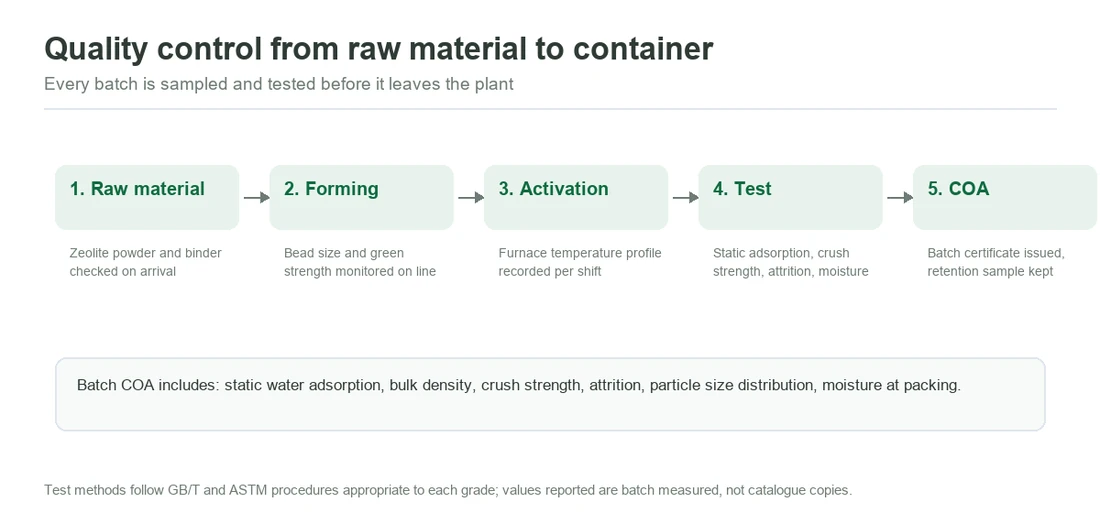
Adsorbent performance is not visible on a delivery note. A lot that is a few percent low on capacity, or a few percent high on fines, shows up months later as a shorter cycle, higher pressure drop or an early bed change. This page sets out what we test, how, and what you get in writing.
8 tests
On every released lot
12 months
Retained samples
Per lot
Measured COA, not an average
Welcome
Your own inspector
What every released lot is tested for
| Property | Method | Typical acceptance |
|---|---|---|
| Static water adsorption | Saturated NaCl at 25 °C / 75% RH (GB/T 6287); vacuum method where agreed | ≥ 20% for 3A / 4A / 5A; ≥ 25% for 13X — per grade TDS |
| Equilibrium CO2 capacity | Volumetric or gravimetric at 25 °C | Per grade TDS — the number that ends an air separation cycle |
| Crushing strength | Mean of 25 beads, tested over the ordered size range | ≥ 40 N for 1.6–2.5 mm; ≥ 60–80 N for 3.0–5.0 mm |
| Attrition / abrasion | Rotating drum or ball-mill attrition test | ≤ 0.20% by weight |
| Bulk density | Tap-and-weigh on the as-shipped sample | 0.60–0.70 g/mL by grade — the number bed volume is calculated from |
| Size distribution | Sieve analysis on a standard ISO / GB sieve set | ≥ 96% within the ordered range |
| Loss on ignition | 550 °C for 1 h | ≤ 1.5% — high LOI means the sieve was packed wet or picked up moisture |
| Moisture as packed | Loss on ignition measured at release | ≤ 1.5% — checked after packing, not only before it |
The COA carries the measured values of the lot you receive. Where a buyer needs a guaranteed minimum rather than a typical value, we agree it before production and put it on the COA.
Traceability
Lot numbering
Every bag is marked with grade, lot number, net weight and production date, so a pallet can be traced back to a production record.
Retained samples
A sample of each released lot is retained for 12 months, so a question months later can still be answered with material.
Independent laboratory
Our QC laboratory is separate from the production operation and releases, or holds, the lot.
Your own inspector
Third-party pre-shipment inspection is welcome. Tell us the scope and we will arrange access.
What we do not claim
- We do not publish a catalogue average as if it were a measured value — the COA carries the measured result.
- We do not quote a certificate we do not hold. Ask for the document and we will send it, or tell you we do not have it.
- We do not claim a REACH registration number we do not hold. We issue a REACH status statement for your compliance file on request.
- We do not substitute a grade without telling you. If a specification cannot be met, you hear it before production, not after shipment.
Documents
Documents
- Certificate of analysis — measured values of the shipped lot
- Technical data sheet — typical specification per grade Download PDF
- Safety data sheet — destination-market format Download PDF
- REACH status statement — issued on request for your tonnage band
Inspection and release, batch by batch


Ask for the COA of the lot you would receive
Email sales@zeolitemolecularsieve.com with the grade and quantity — we will send a recent COA so you can see what we actually release.