



Buyers spend weeks on grade selection and then pick a bead size in thirty seconds, usually by copying whatever was in the vessel before. That single number drives the pressure drop across the bed, the length of the mass transfer zone, how much of the material is actually used before breakthrough, and how much dust you inherit at the next changeout.
It is worth thirty minutes. This is how we work through it with customers.
What bead size actually changes
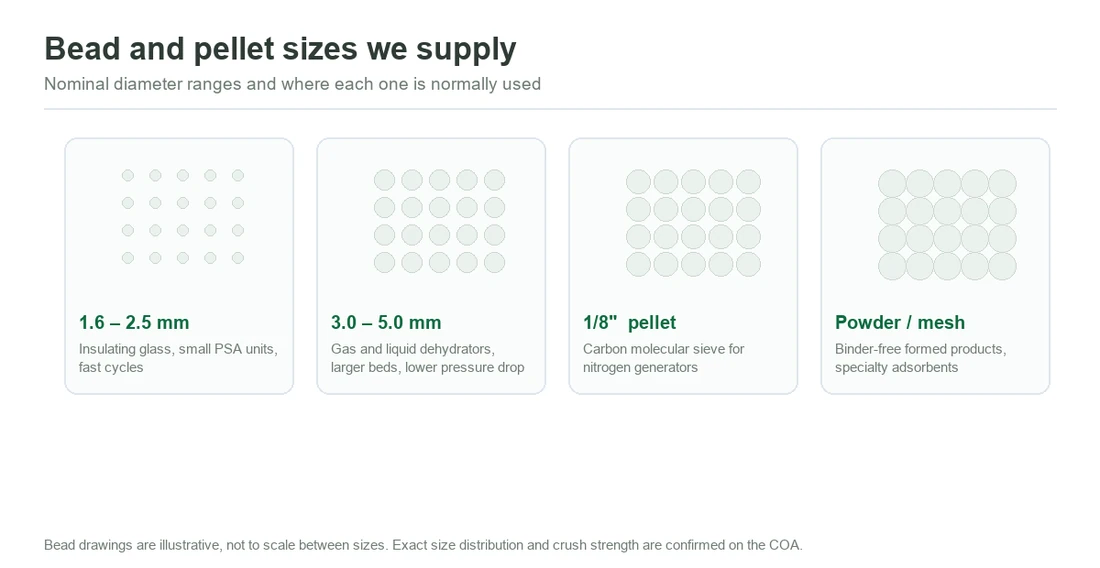
| Bead size | Pressure drop | Mass transfer | Crush strength | Typical service |
|---|---|---|---|---|
| 0.5–1.0 mm (granular) | Very high | Fastest | Lower per bead | Small laboratory or analytical columns, short beds, liquid polishing |
| 1.6 mm (1/16″) | High | Fast | Moderate | Compact PSA units, refrigerant dryers, small diameter vessels |
| 2.5 mm | Moderate | Moderate to fast | Good | General industrial drying, insulating glass desiccant in some systems, mid-size PSA |
| 3.2 mm (1/8″) | Moderate to low | Moderate | High | The workhorse size for gas drying towers and natural gas dehydration |
| 4.8 mm (3/16″) | Low | Slower | Highest | Large diameter beds, high flow, radial-flow vessels, dirty service |
Two physical facts sit behind that table. Pressure drop through a packed bed rises steeply as beads get smaller — the flow area between beads shrinks and the path gets tortuous, so halving the bead size raises pressure drop far more than twofold. And the external surface area per unit volume rises as beads get smaller, which shortens the zone where adsorption is actually happening and lets you use more of the bed.
Start from the pressure-drop budget, not the size
The bed has to fit inside a pressure budget you have already spent elsewhere. A practical way to frame it:
- Total allowable drop across the adsorber is usually set as a fraction of inlet pressure — commonly a few percent, and tighter on vacuum and low-pressure service.
- Divide by bed length to get the drop per metre you can afford. Long, thin beds are far more sensitive to bead size than short, wide ones.
- Then size the bead to use the budget, not to beat it. If a 3.2 mm bead fits the budget, do not go to 4.8 mm “for safety” — you will pay in capacity.
Where flow is high and the vessel is long, the honest engineering answer is often a different vessel, not a bigger bead. A radial-flow bed gives a short flow path and a large face area, which lets you keep a small bead and still stay inside the pressure budget. That is why large PSA and natural gas units use radial beds with 1.6–2.5 mm material rather than axial beds stuffed with 4.8 mm beads.
The cost of oversizing the bead
A bigger bead does not just slow the kinetics; it lengthens the mass transfer zone, and the zone is capacity you paid for and cannot use. In a short cycle, that unused fraction is a large share of the bed.
We see this most often in replacement orders: a plant specifies the same 4.8 mm bead it bought in 2015, on a duty that now cycles twice as fast. The bed passes the acceptance test on day one and starts short-cycling within a year. The fix is usually a smaller bead, not more material.
When a bigger bead is the right call
- Dirty or fouling service. Larger beads tolerate dust, carry-over and minor coking better because the flow channels do not blind as quickly.
- High liquid load or two-phase risk. Strength matters more than kinetics when the bed may see slugs of liquid.
- Very large diameter axial beds where flow distribution is imperfect — a smaller bead there just creates a high-pressure-drop path and worse maldistribution.
- Deep beds with long cycles where the mass transfer zone is a small fraction of bed length anyway. Once the zone is short relative to the bed, the extra kinetics buy nothing.
Screen the material before you load it, not after
Every shipment generates some fines. They come from bead-to-bead attrition in the drum, from handling, and from the loading itself. A bed loaded with fines starts its life with a higher pressure drop than the design and a dust problem at the outlet filter.
- Screen on site through a mesh one step below the nominal size before loading. It takes an hour and saves months.
- Keep the drop height short when loading. Free-falling beads break on the support balls, and broken beads become fines and channels.
- Load in even lifts and level each lift. A cone-shaped pile is a channel waiting to happen.
- Do not walk on the bed without a board, and do not use a hose to “settle” it.
Bead size and vessel internals go together
A 1.6 mm bead cannot sit on the same support as a 4.8 mm bead. The support and the layer of ceramic balls above it must be graded so that each layer retains the one above. Getting this wrong produces a bed that migrates downward, plugs the outlet and shows up months later as sudden pressure drop and dust in the downstream filter.
| Bed layer (top to bottom) | Typical size | Purpose |
|---|---|---|
| Molecular sieve | Selected bead size | Adsorption duty |
| Ceramic ball transition | One or two sizes larger than the bead | Prevents sieve migration into the support |
| Support balls | Graded, increasing downward | Distributes load and flow |
| Support grid / screen | Mesh sized to the smallest ball | Retains the bed |
What we need to recommend a size
Bead size cannot be recommended from a grade name alone. Send:
- Vessel internal diameter and bed depth available
- Flow rate and operating pressure and temperature
- Allowable pressure drop across the bed, in bar or kPa
- Gas or liquid service, and whether the flow is axial or radial
- Whether the vessel may see liquid carry-over or particulate fouling
- Current bead size and why it is being changed, if this is a replacement
Send those to our technical desk and you get a grade recommendation, a datasheet for the exact grade proposed, and a quotation with packaging and Incoterms stated — not a generic price list.
Frequently asked questions
Is a smaller bead always better?
No. A smaller bead gives faster mass transfer and a shorter mass transfer zone, but it raises pressure drop steeply and is less tolerant of fouling and liquid carry-over. The right size is the largest bead that still gives an acceptable mass transfer zone inside your pressure budget.
What bead size is most common for gas drying?
3.2 mm (1/8 inch) is the workhorse for axial gas drying towers, with 1.6 mm used in compact PSA units and 4.8 mm in large or dirty service. The choice should follow vessel geometry and pressure budget, not habit.
Can I mix bead sizes in one bed?
Not within the adsorption layer — mixing causes segregation during loading and uneven flow. Graded sizes belong in the support and transition layers below the sieve, where each layer retains the one above it.
Why did my pressure drop increase after a changeout?
Usually fines from loading, over-fast filling, or a bed that was not screened. It can also be bead migration into the support if the ceramic ball transition is missing or wrongly graded. Check the outlet filter for dust first.
Does bead size affect capacity?
Not the equilibrium capacity per kilogram, but very much the usable capacity. A longer mass transfer zone means a larger fraction of the bed is not yet loaded at breakthrough, so a coarser bead can deliver noticeably less working capacity in a short cycle.
Do you supply the same grade in several bead sizes?
Yes. Most grades are available in a range of bead sizes, and we quote the size that matches your vessel and budget rather than defaulting to one. State the size on the enquiry so the quotation is comparable.
Related reading: 3A molecular sieve, 4A molecular sieve, packaging and shipping, and choosing between desiccants.
Figures marked as typical ranges are indicative values compiled from published supplier datasheets and standard adsorption-engineering references. They describe the class of material, not our specification and not a performance guarantee for your unit. Bed design must be confirmed against your own flow, pressure, temperature and dew-point target.