



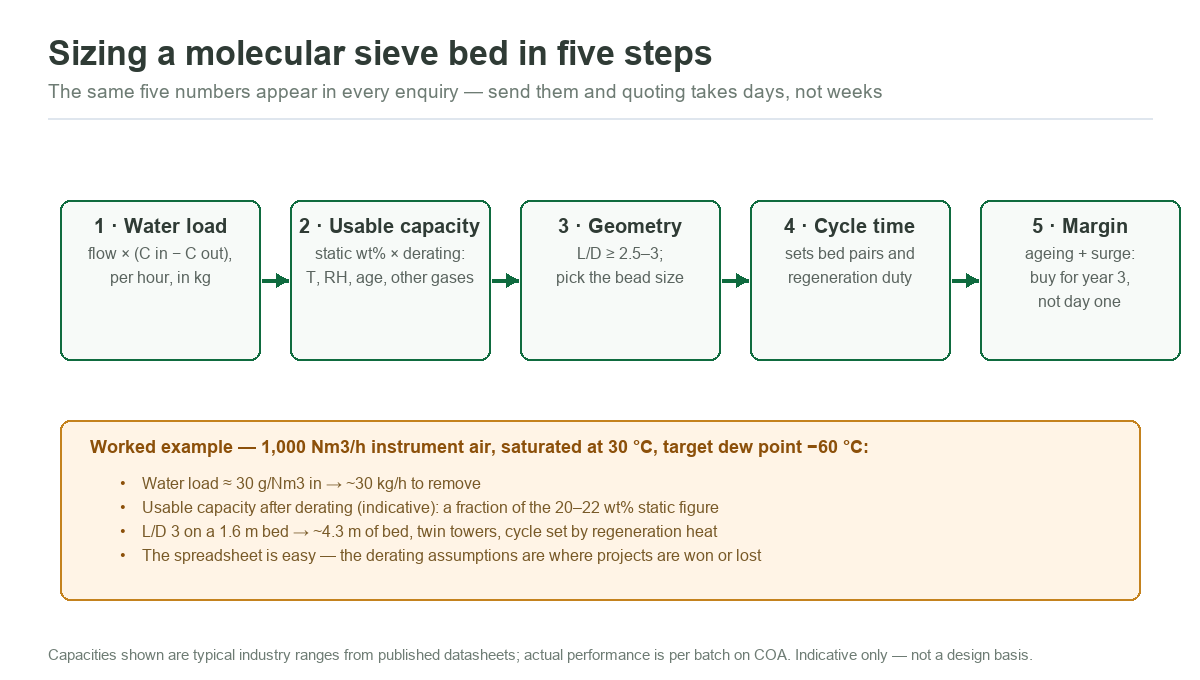
Bed sizing is where sieve projects are won or lost. Not in the datasheet — in the derating assumptions behind it. A bed that is calculated on static capacity alone will miss its dew point within months; the same duty sized honestly runs for years. Here is the five-step method we use when quoting a fill, with a worked example.
Step 1 — Water load
Water load = gas flow × (water in − water out), in kg per hour. “Water in” comes from the stream condition — for saturated air at 30 °C that is about 30 g per Nm³. “Water out” is set by the dew point target and is usually negligible by comparison. Anything already condensed upstream (after a cooler or chiller) is not the sieve’s problem and must not be sized into it.
Step 2 — Usable capacity (the honest part)
A datasheet’s static water capacity — commonly 20–22 wt% for 3A/4A at ambient conditions — is a laboratory ceiling. A working design uses a fraction of it, because real beds lose capacity to:
- Temperature — capacity falls as the bed warms; a 40 °C bed holds much less than a 25 °C one.
- Competing molecules — CO2, H2S and heavy hydrocarbons occupy sites (3A is chosen precisely when you need them ignored).
- Ageing — capacity declines over years of thermal cycling.
- Mass transfer zone — the leading edge of the bed is always part-saturated; only the saturated zone behind it counts at full capacity.
Step 3 — Geometry
Bed depth-to-diameter ratio of at least 2.5–3:1 keeps the flow distribution honest and prevents channelling down the walls. Superficial velocity and the chosen bead size then trade pressure drop against mass transfer rate — small beds on fast cycles want the smaller bead; deep fuel-plant beds want larger beads to keep ΨP survivable.
Step 4 — Cycle time
The adsorption cycle must cover the regeneration duty of the sibling bed: heating, holding, purging and cooling. Short cycles on small dryers run a few hours; large gas plants often run 8-hour or longer beds in a 2+1 arrangement. The cycle also fixes how much water one bed must hold between switchovers — which loops back into step 2.
Step 5 — Margin, applied where it counts
Margin is not a fudge factor bolted on the tonnage. It belongs in the derating: size for year three of capacity, for the hottest feed, for the worst CO2 excursion your process actually produces. Beds bought on day-one numbers are the ones that get topped up — expensively — within two winters.
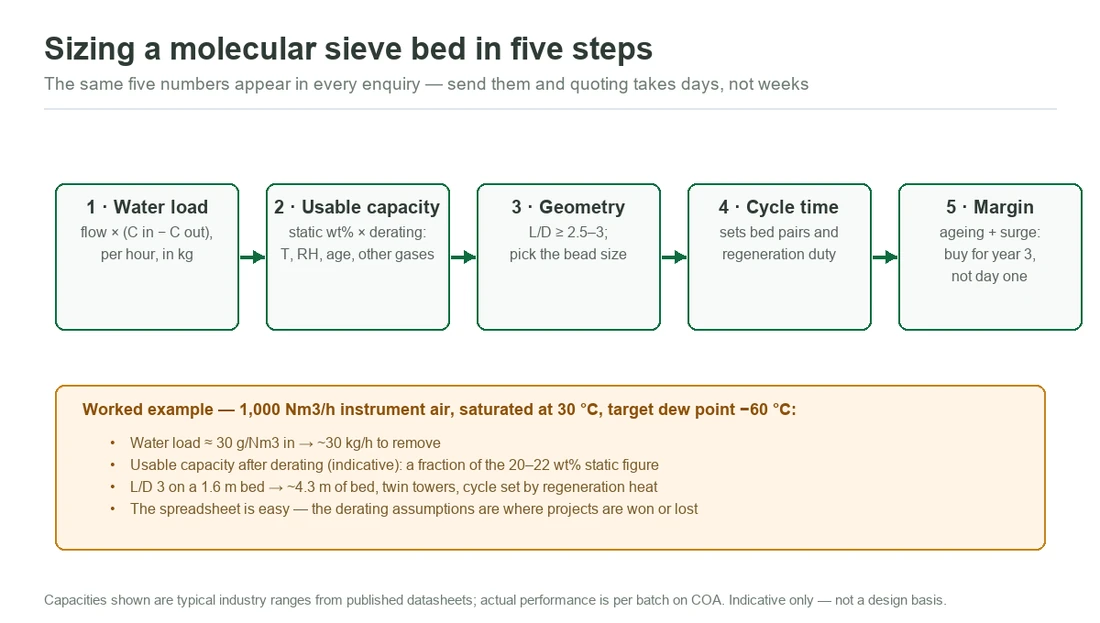
Worked example
Duty: 1,000 Nm³/h instrument air, water-saturated at 30 °C, target atmospheric dew point −60 °C, twin towers.
| Step | Result |
|---|---|
| Water load | ~30 g/Nm³ in → ~30 kg/h to remove |
| Usable capacity | A design fraction of the 20–22 wt% static figure, after temperature, ageing and MZT derating |
| Geometry | L/D 3 on a ~1.6 m diameter vessel → roughly 4.3 m of bed per tower |
| Cycle | Twin towers; cycle length set by regeneration heat duty |
| Margin | Carried inside the capacity derating, not as extra tonnes |
The arithmetic is the easy part. The judgement — what derating your stream deserves — is what a supplier is actually for, and it is why two quotations for the same duty can legitimately differ by 20% in tonnage.
Figures marked as typical ranges are indicative values compiled from published supplier datasheets and standard adsorption-engineering references. They describe the class of material, not our specification and not a performance guarantee for your unit. Bed design must be confirmed against your own flow, pressure, temperature and dew-point target.
Send these four and we will come back with a sized fill, not a guess:
- Gas or liquid, flow rate, and operating pressure and temperature
- Water content of the feed (or the condition it is saturated at) and the outlet target
- Everything else in the stream worth naming: CO2, H2S, heavy hydrocarbons
- Vessel diameter and bed depth if the tower exists — or say it is a new design
Send those to our technical desk and you get a grade recommendation, a datasheet for the exact grade proposed, and a quotation with packaging and Incoterms stated — not a generic price list.
[…] chemistry. Grade selection is a separate conversation, covered in our grade comparison and bed sizing […]