Insulating Glass
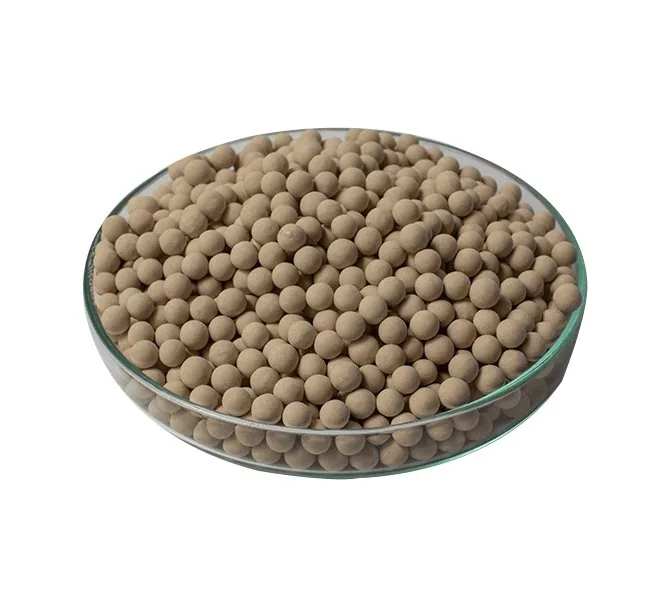
Molecular sieve for insulating glass
Desiccant for spacer profiles — low dust, low nitrogen co-adsorption and fast adsorption at room temperature, so sealed units stay clear and do not flex.
Request a quoteDownload TDS
In a sealed double or triple glazing unit, any moisture left inside the cavity will condense on the glass as the temperature falls. The desiccant in the spacer removes that moisture and keeps the unit clear.
3A molecular sieve is the standard desiccant for this application. The bead size and filling method are selected to suit the spacer profile and the automatic filling line.
Low dust filling
Beads screened for low dust so automatic filling lines run clean and spacers seal properly.
No nitrogen uptake
3A is used rather than 4A because it does not adsorb nitrogen, which avoids glass deflection.
Fast at room temperature
Picks up the moisture trapped in the cavity quickly during and after filling.
Recommended Grades
- 3A Molecular Sieve — Standard desiccant for sealed insulating glass units.
Typical service conditions
| Parameter | Typical range | Why it matters |
|---|---|---|
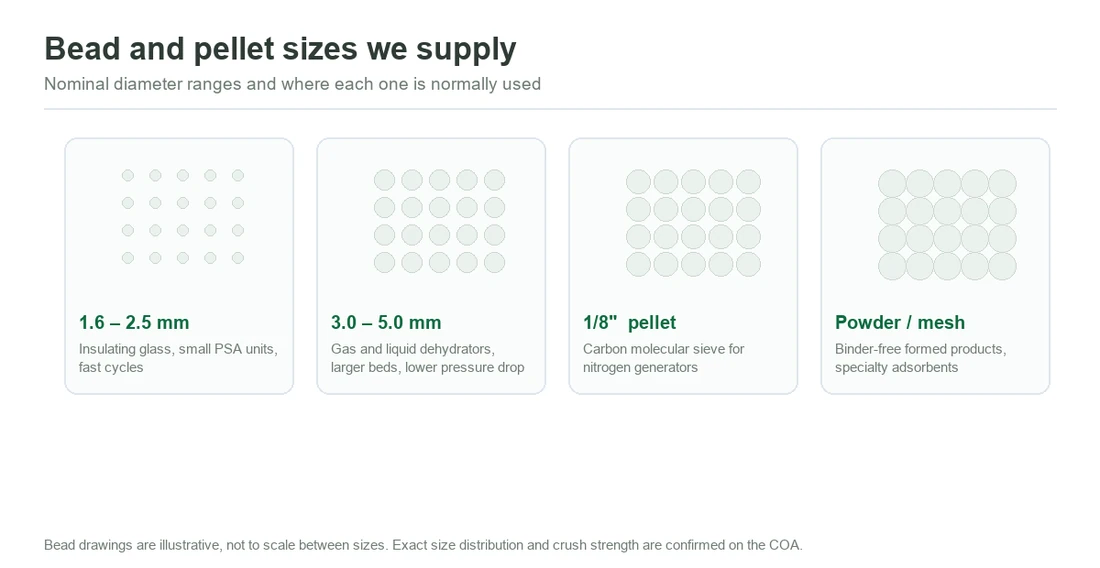
| Bead size | 0.5–1.0 mm / 1.0–1.6 mm | Matched to the filling machine |
| Filling density | Approx. 0.7–0.8 g/cm³ | Used to convert cavity volume to weight |
| Adsorption temperature | Room temperature | Capacity must hold at low temperature |
| Gas filling | Air or argon | Argon units need a dry cavity before filling |
| Service life | Life of the sealed unit | Set by seal quality, not by the sieve |
Information We Need to Quote
| Item | Your value |
|---|---|
| Spacer profile and cavity width | e.g. 6A aluminium spacer |
| Filling method (automatic / manual) | e.g. automatic filling machine |
| Required bead size range | e.g. 0.5–1.0 mm |
| Gas filling (air / argon) | e.g. 90% argon fill |
Documents
- Technical Data Sheet (TDS) — available on request Download PDF
- Safety Data Sheet (SDS) — available on request Download PDF
- Certificate of Analysis — issued per lot, based on batch test results
Frequently Asked Questions
Why is 3A used and not 4A?
The cavity of a sealed unit is a fixed volume. 4A can co-adsorb nitrogen, which changes the pressure inside the unit and can cause the glass to deflect. 3A adsorbs water with far less nitrogen uptake, so the unit stays dimensionally stable.
How much desiccant is needed per unit?
The filling quantity depends on spacer width, cavity volume and unit dimensions. Tell us the profile and unit size and we will confirm the recommended fill.
What causes fogging after installation?
Fogging usually points to moisture that was not fully adsorbed, a desiccant that was already saturated when loaded, or a seal failure. Storage and handling practice before filling is a common cause.
Factory-Direct Supply
We manufacture molecular sieve at our own plant and export directly to industrial buyers and distributors — no trading layer between the production record and your certificate of analysis. Every lot is tested before release and shipped with a lot-specific COA. How we make it · Quality control · Request a factory quote
Insulating glass duty
3A beads keep the cavity dry without co-adsorbing the gas fill, so the glass stays flat.