



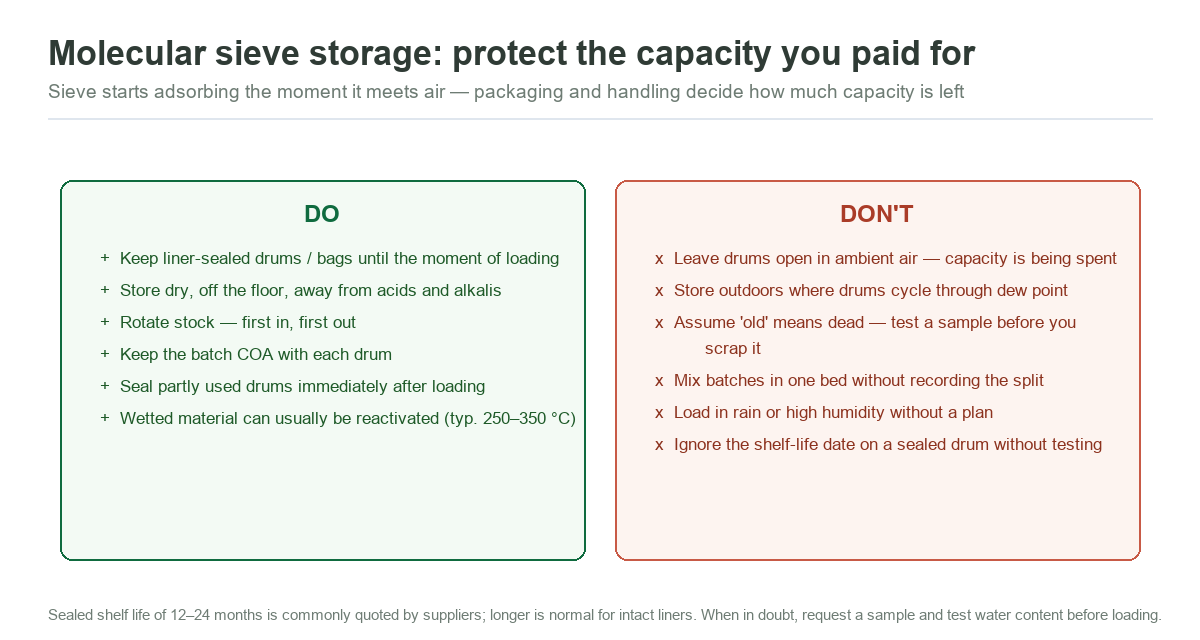
Molecular sieve starts working the moment it meets air. Every hour a liner is open in a humid warehouse, part of the capacity you paid for is quietly being spent. Storage is not a formality — for some orders it decides whether the bed meets dew point on day one.
What shelf life actually means
Suppliers commonly quote 12–24 months shelf life for factory-sealed material, and intact liner-sealed packaging frequently keeps longer than the label in dry indoor storage. The date on the drum is a packaging warranty, not a chemistry countdown: what actually ages sieve in storage is moisture pickup through compromised packaging, not the passage of time itself.
- Sealed, intact, dry indoor storage: the packaged residual moisture (commonly specified at ≤1.5%) is essentially what you will unload.
- Sealed but stored outdoors: drum cycling through the dew point breathes moisture past closures over months. Some capacity is being spent invisibly.
- Opened and left open: ambient air at 50% RH is, to a sieve, a working gas stream. Hours matter, not weeks.
Warehouse rules that protect the tonnage
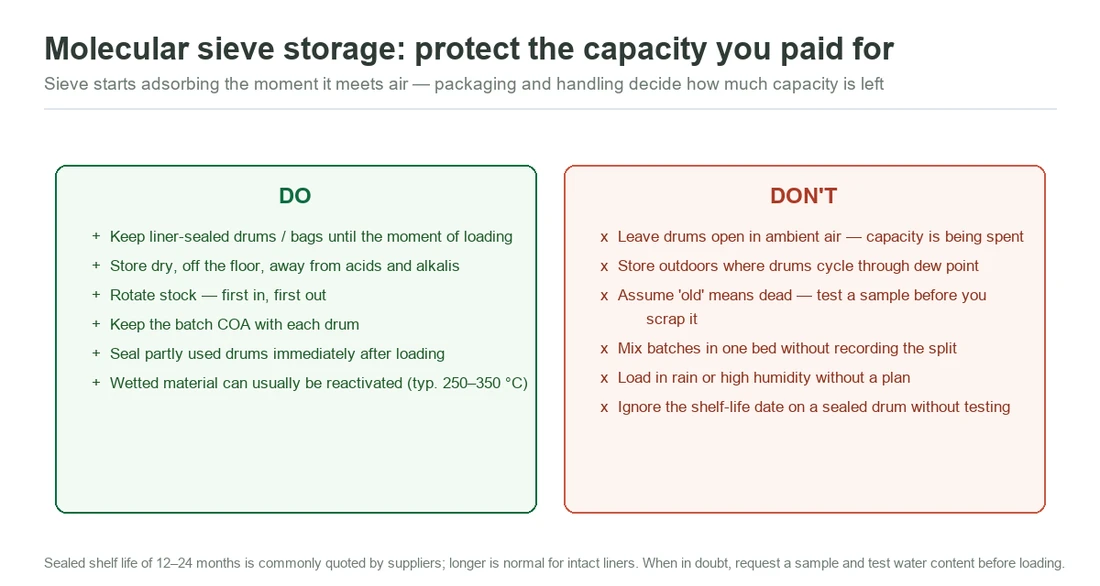
- Keep liner-sealed drums and bags closed until the moment of loading.
- Store dry, off the floor, away from acids, alkalis and solvent stores.
- Rotate stock first-in-first-out; keep each batch’s certificate of analysis with the drums.
- Reseal partly used containers immediately after drawing material.
- Record which batches went into which bed — future diagnosis will thank you.
- Never load in rain or heavy humidity without a plan: tents, dry-air purge, or postpone.
Exposed material: scrap or reactivate?
Molecular sieve is not single-use, and neither is most storage damage. Type A sieve that has picked up ambient moisture can usually be reactivated by heating — typically in the 250–350 °C range with adequate ventilation — and returned to stock or loaded directly hot into a system that will purge it dry. What reactivation cannot undo:
- Contamination — oils, amines or process chemicals adsorbed in storage that regeneration will not cleanly drive off.
- Mechanical damage — drums that took water and froze/thawed, crushed beads, dust generation.
- Unknown history — if nobody can say what the drum sat in, test before you trust it.
The practical rule: an old drum with intact packaging and a COA is usually good material. A young drum that sat open for a summer may not be. When in doubt, request a sample and have water content tested before the loading crew arrives.
Figures marked as typical ranges are indicative values compiled from published supplier datasheets and standard adsorption-engineering references. They describe the class of material, not our specification and not a performance guarantee for your unit. Bed design must be confirmed against your own flow, pressure, temperature and dew-point target.
Unsure whether stored material is still good? We will help you decide test-versus-scrap:
- The grade, bead size and quantity you plan to store or load
- Storage conditions: indoors/outdoors, climate, expected storage duration
- Whether the packaging is factory-sealed or partly used
- If reactivation is being considered: the oven or purge capability on site
Send those to our technical desk and you get a grade recommendation, a datasheet for the exact grade proposed, and a quotation with packaging and Incoterms stated — not a generic price list.