



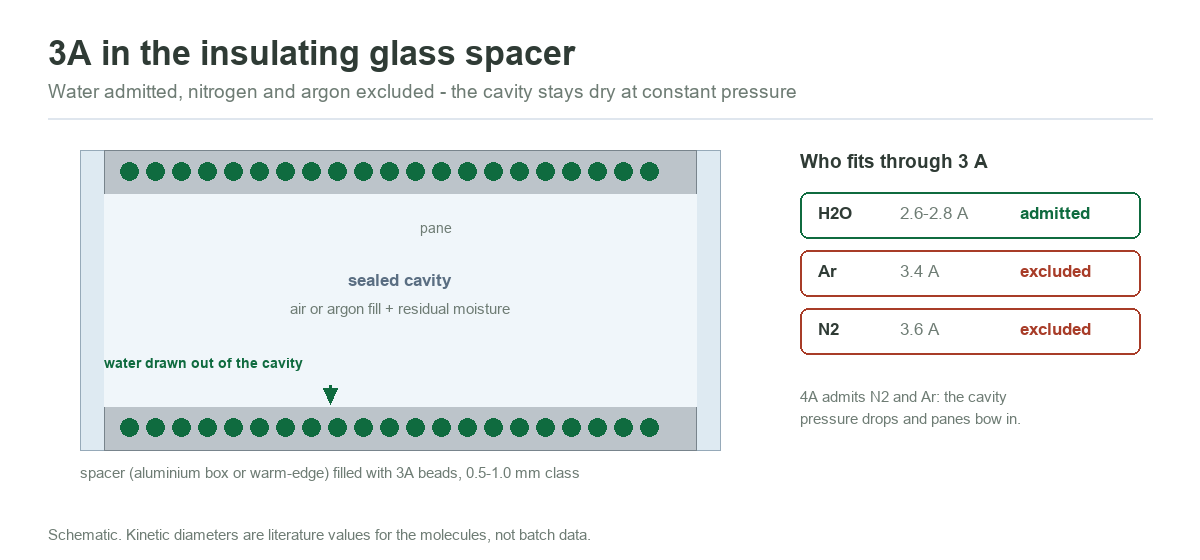
An insulating glass unit is a closed volume of gas trapped between two panes. Its enemy is water: any residual moisture left inside at sealing will condense on cold glass as fog, and any chemistry that changes the amount of gas in the cavity changes the pressure the panes see. Both problems are solved by one small decision — the desiccant in the spacer — and that desiccant is 3A molecular sieve.
The geometry argument
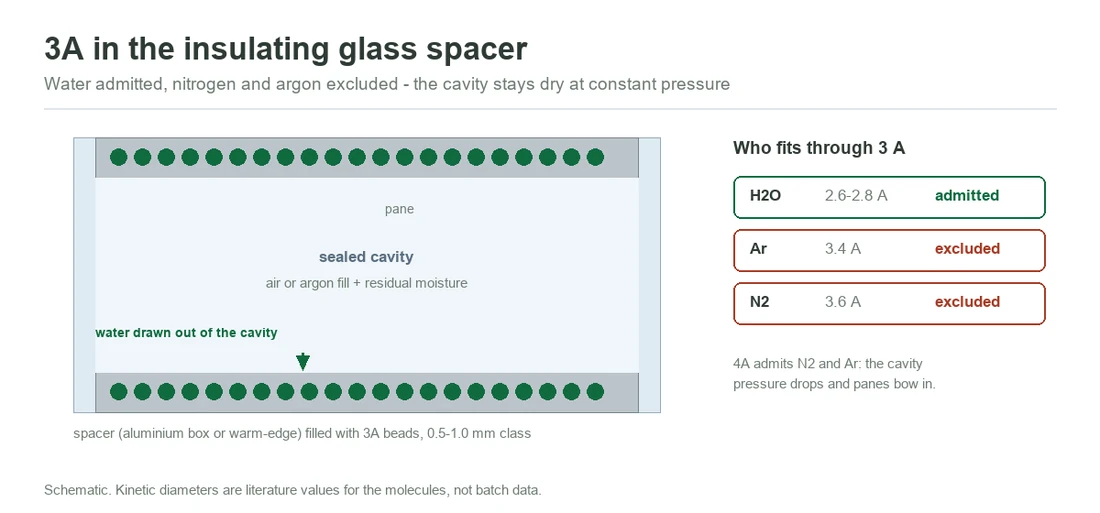
The cavity is a sealed box of fixed volume. Whatever the desiccant adsorbs from that box, the pressure drops by the same proportion. A water molecule, with a kinetic diameter near 2.6–2.8 Å, passes the 3 Å window of the 3A crystal. Nitrogen at about 3.6 Å and argon at about 3.4 Å do not. So 3A takes the water and leaves the gas — which is exactly what a sealed unit wants.
- 4A is the classic failure: its 4 Å window admits nitrogen. In an air-filled cavity the 4A bed pumps N2 out of the gas phase, the cavity pressure falls below atmospheric, and the panes bow inward. The unit looks fine the day it is glazed and distorted a month later.
- Argon-filled units are no safer with 4A: argon also fits the 4 Å pore. The fill you paid for migrates into the beads.
- 13X is worse again: the wide pore admits a range of species, none of which belong in the adsorbent of a sealed cavity.
What the desiccant has to do, and for how long
The spacer desiccant has two jobs. First, finish the drying: pull the residual moisture of the manufacturing air down to the point where the dew point inside the cavity sits well below the coldest service temperature, so no pane ever fogs. Second, hold that state for decades against slow moisture penetration through the edge seal — the durability that European IG standards test by moisture ingress and fogging behaviour over accelerated aging.
That second job is why capacity at low relative humidity matters more than capacity at saturation. A desiccant that holds a lot of water at 100% RH may hold little at the few-percent RH that a cavity actually runs at. The low-RH isotherm is the curve that separates IG-grade 3A from generic 3A.
Physical form and filling practice
IG desiccant is supplied as small beads — commonly in the 0.5–1.0 mm class and as blends — sized to fill the narrow channel of an aluminium box spacer or a warm-edge profile quickly and completely. Two practical rules from glazing floors:
- Fill immediately before sealing. The beads start work on room air the moment they are exposed; a hopper left open overnight spends capacity that was bought for the cavity.
- Dust control is a quality issue. Fines migrate into the corner keys and the primary seal. Low-attrition material and gentle handling are part of the specification, not a nicety.
Spec lines for IG-grade 3A
- Water adsorption at low RH (with the RH and temperature stated) — the number that predicts fogging performance, per batch on the COA.
- N2 / Ar non-adsorption — the whole point of the grade; verify the aperture discipline in the supplier’s data.
- Attrition and dust — protects corner joints and seals.
- Bead sizing and blend consistency — governs fill density in the spacer channel.
- Packed water content — arrives dry, sealed, with the batch certificate.
Figures marked as typical ranges are indicative values compiled from published supplier datasheets and standard adsorption-engineering references. They describe the class of material, not our specification and not a performance guarantee for your unit. Bed design must be confirmed against your own flow, pressure, temperature and dew-point target.
Buying 3A for IG spacers? Tell us the glazing system and you get:
- Spacer system: aluminium box, warm-edge profile, or butyl channel
- Gas fill: air or argon, and the target internal dew point
- Annual unit output, so packaging sizes line up with production
- Whether you need a blended bead or a single fraction
Send those to our technical desk and you get a grade recommendation, a datasheet for the exact grade proposed, and a quotation with packaging and Incoterms stated — not a generic price list.
Related pages on this site
- Insulating glass application page
- 3A molecular sieve product page
- 3A in ethanol dehydration
- Storage rules that protect desiccant before it is filled
Frequently asked questions
Why is 3A used in double glazing?
Because the 3 angstrom pore admits water (about 2.6-2.8 angstrom) and excludes nitrogen (about 3.6) and argon (about 3.4). The cavity stays dry at constant pressure — no fogging, no bowing.
Can I use 4A in insulating glass?
No. 4A co-adsorbs nitrogen and argon from the sealed cavity. The pressure drops below atmospheric and the panes bow inward — a delayed, visible failure that appears weeks after glazing.
How much desiccant goes into a spacer?
The mass per metre is set by the glazing system and the moisture-load calculation for the unit’s service life. The spacer supplier’s filling spec governs; we supply bead grades and blends to match it.
What causes fogging between double-glazed panes?
Residual moisture inside the cavity, or seal failure admitting moisture faster than the desiccant can absorb it. Both trace back to desiccant quality, fill practice and seal workmanship.
Does the desiccant in IG units ever need replacing?
No — it is designed to hold for the life of the seal. When a unit fogs,the seal has failed, and the unit is replaced, not re-dried.