



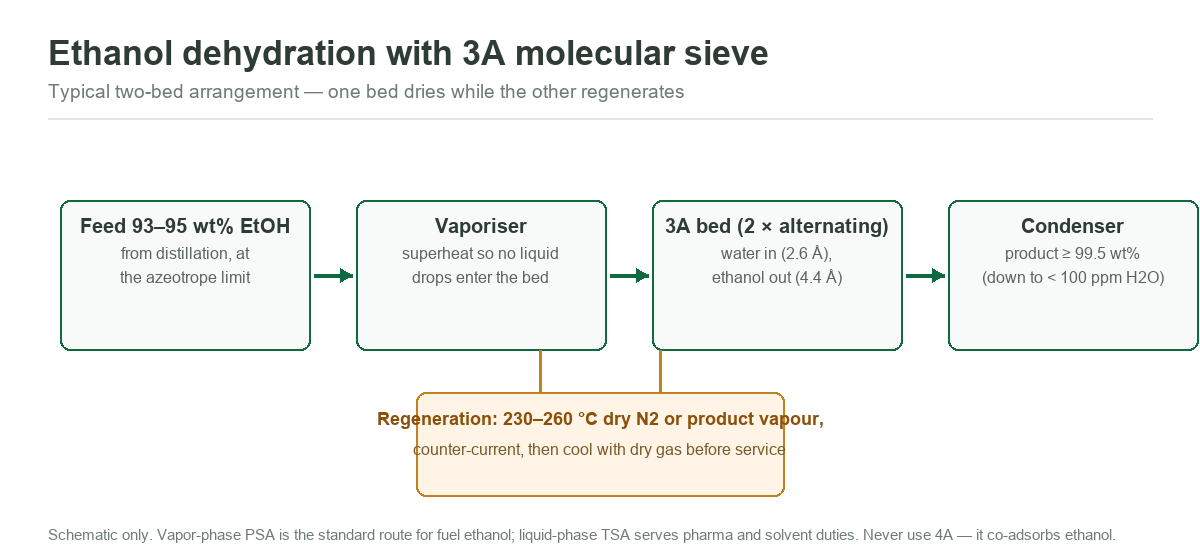
Distillation stops at the azeotrope: around 95.6 wt% ethanol, no conventional column goes past it. Everything beyond that point — fuel ethanol, pharma-grade alcohol, solvent recovery — belongs to adsorption, and in practice that means 3A molecular sieve. This page is the technical brief we send to ethanol producers asking for a dehydration grade.
Why 3A and only 3A
The selectivity is pure geometry. A water molecule has a kinetic diameter of roughly 2.6–2.8 Å and slips through the 3 Å aperture of the 3A crystal. An ethanol molecule is about 4.4 Å and is excluded. The sieve takes the water and lets the product pass — virtually no ethanol is adsorbed, so there is no product hold-up in the bed and no ethanol vapour load on the regeneration heater.
- 4A is the classic mistake. Its 4 Å aperture admits ethanol as well as water. The result is product loss, a heavy ethanol load in the regeneration off-gas, and regeneration heat spent desorbing alcohol instead of water. Ethanol plants do not use 4A.
- 13X is worse still for the same reason — larger aperture, stronger adsorption, more product in the bed.
- 3A is graded for the duty. Ethanol-duty 3A emphasises high crush strength and low attrition, because a deep industrial bed sees real mechanical load over years of service.
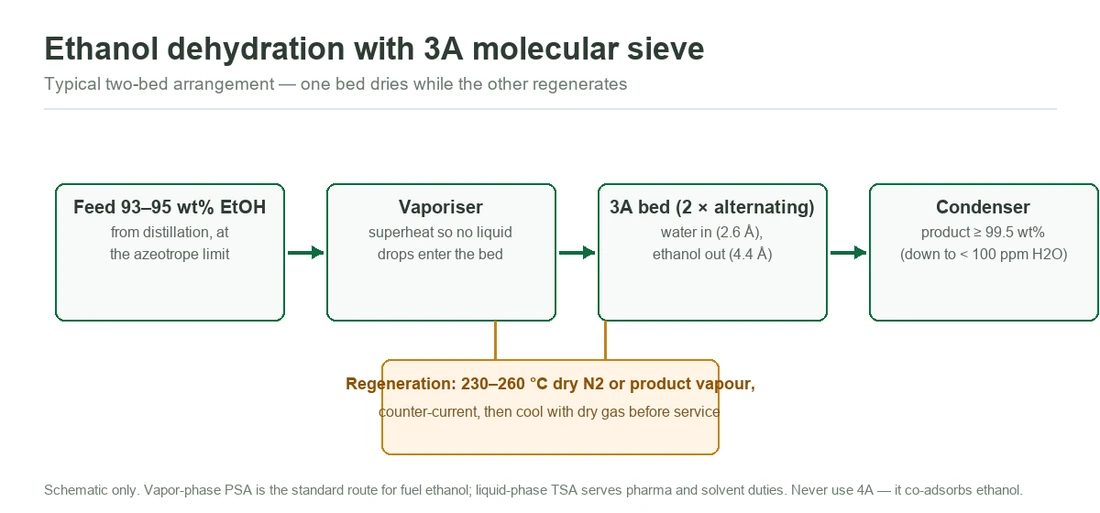
Two process routes
- Vapour-phase PSA — the fuel-ethanol standard. Rectified spirit at 93–95 wt% is vaporised and superheated (no liquid droplets may enter the bed — liquid carryover is the fastest way to destroy a sieve bed), passed through the adsorber, and the dry vapour is condensed as ≥99.5 wt% product. Two or more beds alternate; saturated beds regenerate with hot dry vapour or nitrogen.
- Liquid-phase TSA — pharma and solvent duties. Liquid ethanol passes through a fixed bed for deep polishing to very low ppm water. Regeneration uses hot dry nitrogen, typically 230–260 °C, followed by a cool-down period before the bed returns to service — feeding hot alcohol off a fresh regeneration can drive side reactions that create aldehydes and ethers.
Both routes land in the same place on product quality: 99.5 wt% and better, with residual water commonly quoted down to below 100 ppm on a well-designed train.
What a good ethanol-duty 3A looks like
The numbers below are the ranges commonly specified for ethanol-duty spherical 3A, tested to GB/T 10504 methods. They are industry-typical values — the binding figures for any shipment are the ones on that batch’s certificate of analysis.
| Property | Typical specification | Why it matters in ethanol service |
|---|---|---|
| Static water adsorption (25 °C) | ≥20 wt% | Capacity per kilogram — the base of your bed sizing |
| Bulk density (bead) | 0.66–0.70 g/mL | Set by bead size; converts bed volume into tonnes to buy |
| Crush strength | ≥40 N (1.6–2.5 mm) / ≥70 N (2.5–4 mm) | Survives loading and years of pressure cycling |
| Attrition / dust | ≤0.20% | Dust blinds filters and erodes valves downstream |
| Packaged residual moisture | ≤1.5% | You are buying capacity, not pre-spent capacity |
Bead size follows the plant: 1.6–2.5 mm for smaller liquid-phase and fast-cycle units, 2.5–4 mm and larger for big continuous fuel-ethanol beds where pressure drop across a deep bed is the operating cost that never stops.
Regeneration: the window that decides bed life
- Temperature: 230–260 °C is the working window. Hot enough to drive the water off, not so hot that trace organics crack and coke on the crystal. Consistently running past about 280 °C is a common cause of capacity fade.
- Gas: dry nitrogen or dry product vapour, counter-current to adsorption flow, so the water exits through the freshest end of the bed.
- Cool-down: return the bed to feed temperature on dry gas before switching back in — especially in liquid service.
- Life: on clean feed with disciplined regeneration, 3–5 years is a normal planning figure, and longer is commonly reported in gentle service.
The failure modes we actually get called about
- Liquid carryover into a vapour-phase bed — thermal shock cracks beads into dust. Superheat margin and a knock-out drum are cheaper than a refill.
- Overheated regeneration — coking, gradual capacity loss, rising product water.
- Feed contamination — alkaline or acidic carryover attacks the crystal lattice. Filtration and upstream chemistry control are part of the sieve specification, not an afterthought.
Figures marked as typical ranges are indicative values compiled from published supplier datasheets and standard adsorption-engineering references. They describe the class of material, not our specification and not a performance guarantee for your unit. Bed design must be confirmed against your own flow, pressure, temperature and dew-point target.
When you ask for a quote, these four lines are enough for us to size the fill:
- Feed flow (kg/h or L/h) and hours per day of operation
- Ethanol content of the feed and the water specification you must hold (wt% or ppm)
- Vapour-phase or liquid-phase design, and your regeneration heat source
- Bed dimensions if the tower already exists, or the duty if it is a new design
Send those to our technical desk and you get a grade recommendation, a datasheet for the exact grade proposed, and a quotation with packaging and Incoterms stated — not a generic price list.