



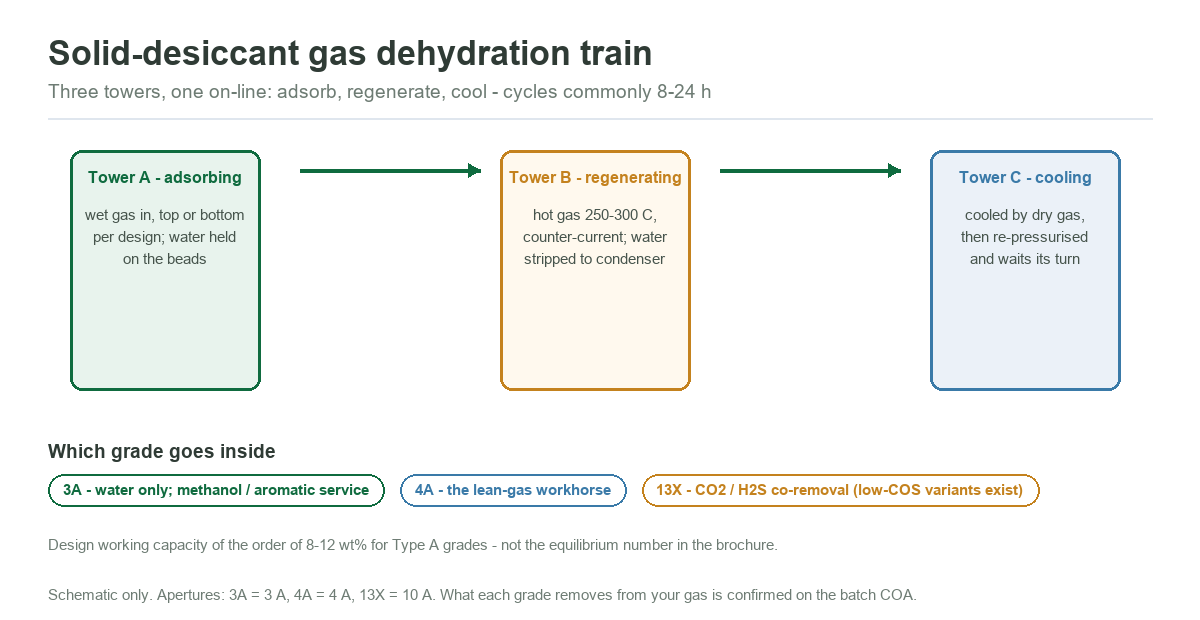
Gas leaves the well or the glycol unit wet, and the pipeline will not take it that way. Tariff water specs are commonly quoted in pounds of water per million standard cubic feet — single digits — and cryogenic NGL, LNG and liquid-desiccant-fouling services push the target below one part per million. Molecular sieve is the technology that gets there. The engineering question is not whether to use sieve, but which grade, and how the cycle is built around it.
Three grades, three duties
| Grade | Aperture | Takes | Chosen when |
|---|---|---|---|
| 3A | 3 Å | Water only | Methanol or heavy aromatics are present — nothing else fits the pore, so regen heat and product loss stay low |
| 4A | 4 Å | Water, CO2 (partly), methanol… | The lean-gas workhorse for dew pointing and general dehydration |
| 13X | 10 Å | Water, CO2, H2S, heavier species | Bulk CO2 / mercaptan co-removal; sour service — with the COS caveat below |
Aperture figures are the crystal’s own; what each grade removes from your gas is confirmed by the batch COA and, ideally, a bench test on the actual feed.
The COS trap in sour service
In gas carrying both H2S and CO2, some sieve surfaces can catalyse the reaction that converts them toward carbonyl sulphide — a contaminant that is easy to create and hard to remove, and a common root cause of out-of-spec sulphur in down-stream product. Where sour gas is dried on molecular sieve, the grade and its COS behaviour are a legitimate line of questioning for the supplier, and low-COS variants of the common grades exist precisely for this duty. Ask for the data before the bed is loaded.
Cycle design: where capacity is actually won
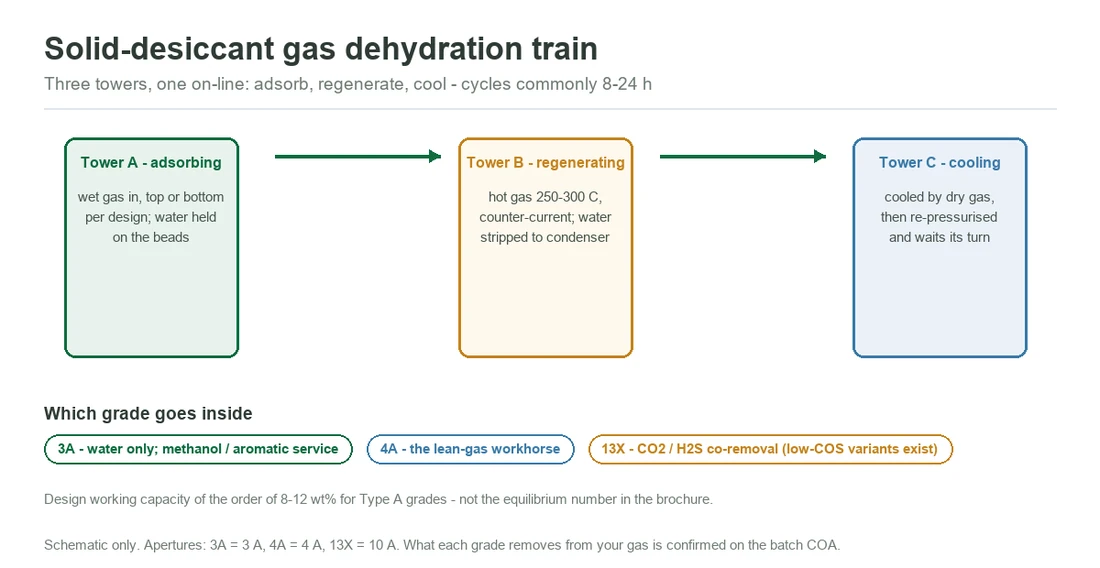
Solid-desiccant dehydration runs two or three towers — one adsorbing, one regenerating, one cooling or standing by — on cycles commonly in the 8–24 hour band. The capacity you buy is not the equilibrium capacity printed in the brochure. It is the working capacity, which the design engineer derates for:
- Inlet water content at the worst-case temperature and pressure.
- Mass-transfer zone length — the moving front that never fully saturates.
- Residual water left after every regeneration, which sets the floor the next cycle starts from.
- Ageing — capacity decays over years of thermal cycling, so the first cycle is not the design case, the last one is.
Design working capacities commonly assumed for Type A sieve are of the order of 8–12% by weight against equilibrium values well above 20% — the difference between those two numbers is the cycle, the regeneration quality and the inlet conditions. A quote built on equilibrium capacity is selling you a bed that will breakthrough early.
Regeneration, in brief
Hot regeneration gas — typically dry treated gas at roughly 250–300 °C — flows counter-current or co-current per the design, strips the water, and carries it to condensation and disposal. Inlet quality discipline matters more than any brand choice: a slug of brine, compressor oil or glycol carry-over does more damage in one afternoon than a year of well-behaved cycles.
The COA lines to insist on
- Static water adsorption at stated conditions (the classic saturated-salt / vacuum methods are both acceptable if stated).
- Crush strength — deep industrial beds see real mechanical load.
- Attrition / dust — fines migrate, block screens and end up in your separators.
- Bulk density — tonnage versus vessel volume.
- Packed water content — the lot should arrive dry.
Figures marked as typical ranges are indicative values compiled from published supplier datasheets and standard adsorption-engineering references. They describe the class of material, not our specification and not a performance guarantee for your unit. Bed design must be confirmed against your own flow, pressure, temperature and dew-point target.
Choosing between 3A, 4A and 13X? We will help you decide:
- Gas composition and the water spec you must meet (lb/MMscf or ppmv)
- Whether methanol, aromatics, H2S or CO2 are present in meaningful amounts
- Operating pressure and temperature, and available regeneration gas
- Existing vessel dimensions, if this is a rebed rather than a new unit
Send those to our technical desk and you get a grade recommendation, a datasheet for the exact grade proposed, and a quotation with packaging and Incoterms stated — not a generic price list.
Related pages on this site
- Natural gas dehydration application page
- 3A molecular sieve
- 4A molecular sieve
- 13X molecular sieve
- How to size a molecular sieve bed: five steps
Frequently asked questions
Which molecular sieve is best for natural gas dehydration?
4A is the lean-gas workhorse. 3A is preferred where methanol or heavy hydrocarbons are present, because the 3 Å pore admits water and excludes almost everything else. 13X is chosen when CO2, H2S or mercaptans must come off with the water.
How dry can molecular sieve get natural gas?
To below one part per million of water where the service needs it — the region required for cryogenic NGL recovery and LNG feed. Pipeline tariff specs of a few pounds per MMscf are comfortably met.
What is working capacity versus equilibrium capacity?
Equilibrium capacity is what the sieve holds in a lab at saturation; working capacity is what the bed delivers between regenerations after the mass-transfer zone, residual water and ageing are accounted for. Designs commonly assume of the order of 8–12 wt% for Type A grades.
Does molecular sieve form COS in sour gas?
On gas containing H2S and CO2 together, some sieve surfaces can catalyse COS formation. Where this matters, specify a low-COS variant and ask for the supplier’s data on that duty.
How long does a dehydration bed last?
Bed life is measured in years and is governed by regeneration quality and feed cleanliness far more than by the zeolite itself. Oil, brine or glycol carry-over is what kills beds early.