



Biomethane is the fastest-growing adsorbent market in our order book, and it is also where we see the most mismatched specifications. The reason is simple: a biogas plant does not buy “a molecular sieve”. It buys one of three different duties, and the grade that suits one will fail in another.
What is actually in raw biogas
| Component | Typical range | Why it matters to the adsorbent |
|---|---|---|
| Methane | 50–70 vol% | The product; also the gas you do not want to adsorb |
| Carbon dioxide | 30–50 vol% | The main duty in most upgrading trains; strongly adsorbed on 13X and CMS |
| Water | Saturated at digester temperature | Adsorbed preferentially over everything; must be removed before CO2 duty |
| Hydrogen sulphide | 100–4,000 ppm, highly variable | Poison and odour; must be removed upstream of any sieve |
| Siloxanes | Landfill and wastewater digesters | Convert to silica on regeneration — irreversible bed destruction |
| Oxygen | 0–1 vol% | Reduces methane purity, promotes coke formation with hydrocarbons |
| Nitrogen | 0–3 vol% | Not removed by water wash or amine; needs a separate step |
| Ammonia, VOCs, particulates | Trace to ppm | Compete for sites; particulates blind the bed surface |
Three duties, three different grades
- Duty 1 — bulk CO2 removal by PSA. 13X or carbon molecular sieve, in a multi-bed cycle at elevated pressure with vacuum or low-pressure regeneration. This is a CO2 separation duty, not a drying duty.
- Duty 2 — final drying after water wash, amine wash or membrane. 3A or 4A, polishing to a dew point that meets grid or liquefaction specification. Small bed, long life, if the upstream does its job.
- Duty 3 — guard duty. A sacrificial layer ahead of the main bed to catch H2S, ammonia or carry-over. Cheap material, replaced often, protecting expensive material.
Quotations go wrong when a plant specifies duty 1 material for a duty 2 application, or the reverse. A 13X bed used only for polishing drying will adsorb CO2 as well, and if the regeneration cycle was designed for water only, the CO2 never fully comes off and capacity falls cycle by cycle. Tell the supplier which duty you are buying for.
13X versus carbon molecular sieve for CO2
| Property | Zeolite 13X | Carbon molecular sieve |
|---|---|---|
| CO2 capacity | High, equilibrium-driven | Moderate, kinetics-driven |
| CH4 co-adsorption | Low to moderate | Higher, which is why cycle timing matters |
| CO2/CH4 selectivity | High at equilibrium | Lower at equilibrium, relies on rate difference |
| Water tolerance | Adsorbs water strongly — needs upstream drying | Also adsorbs water, and water degrades the kinetics |
| Regeneration temperature | Higher, typically 180–280 °C for thermal swing | Lower for the same duty |
| Behaviour on feed variation | Steep isotherm buffers variation, more stable methane content | More sensitive to cycle timing than to composition |
| Relative cost | Lower per tonne | Several times higher per tonne |
The choice is usually made by the process licensor, not by the plant, because it is tied to the cycle design. What the plant controls is the quality of the material delivered against that design: bead size for the pressure drop, crush strength for the cycling, and a certificate that matches the batch.
The upstream train decides whether the bed survives
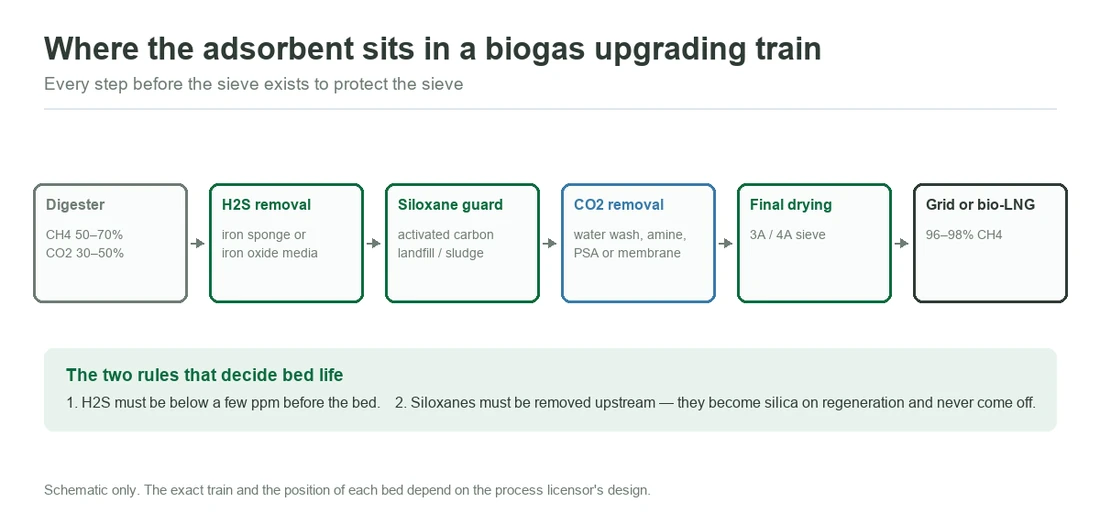
This is the part we repeat most often, because it is the part that gets cut when a project budget is tight.
- H2S removal is not optional. Iron sponge, iron oxide media or a biological scrubber, followed by activated carbon, and sized for the peak H2S concentration rather than the average. Digester H2S swings by a factor of five with feedstock changes.
- Siloxane removal is not optional either, if the feedstock includes landfill or wastewater sludge. Activated carbon or a dedicated silica bed upstream. Once siloxane reaches a sieve, every regeneration deposits a little more silica inside the pore and the capacity never comes back.
- Water knockout before the bed. A coalescing separator and a knock-out drum cost far less than the capacity they protect.
- Particulate filtration. Digester foam and carry-over blind the top of the bed and raise pressure drop without showing up in any gas analysis.
A well-designed guard train costs a modest fraction of the PSA capex and pays it back through adsorbent life. We have quoted replacement beds for plants that skipped it, and the second bed is always more expensive than the guard would have been.
Methane loss and the regeneration gas
Every PSA cycle loses some methane with the waste gas. The two levers are cycle design and adsorbent selection, and both need real numbers rather than rules of thumb:
- CH4 co-adsorption on the chosen grade sets the floor on loss. A material with a flatter methane isotherm gives more room to manoeuvre on cycle time.
- Regeneration pressure determines how much of the adsorbed CO2 comes off, and therefore how much capacity is available next cycle.
- Recycle of the regeneration tail back to the compressor inlet recovers methane but raises the CO2 load on the bed, which is a real trade-off, not a free gain.
- Bed size for the worst feed, not the average. A plant designed on 55% methane will struggle at 50%.
Specification data we need to quote a biogas bed
Biogas is the application where a wrong first specification is most expensive, because the failure shows up after a year of operation. Send:
- Raw biogas flow (Nm³/h) and the upgrading route: water wash, amine, PSA or membrane
- Full composition including CO2, H2S, O2, N2, water and any siloxane analysis
- Target output: grid injection methane content, or bio-LNG specification
- Adsorption and regeneration pressures and temperatures in the cycle design
- Vessel dimensions, number of beds and cycle time, if the design is fixed
- Feedstock type — energy crop, manure, landfill or wastewater — because it sets the poison load
Send those to our technical desk and you get a grade recommendation, a datasheet for the exact grade proposed, and a quotation with packaging and Incoterms stated — not a generic price list.
Frequently asked questions
Which molecular sieve is used for biogas upgrading?
It depends on the duty. 13X and carbon molecular sieve are used for bulk CO2 removal by pressure swing adsorption; 3A and 4A are used for final drying after water wash, amine wash or membrane separation. The two duties need different grades and different cycles.
Can molecular sieve remove H2S from biogas?
It will adsorb H2S, but it should not be the primary removal step. H2S is strongly held and competes with the main duty, and the bed will need frequent regeneration at high temperature. A dedicated upstream guard — iron sponge or iron oxide media plus activated carbon — is the standard arrangement.
Why do siloxanes destroy molecular sieve beds?
On each regeneration cycle siloxanes are oxidised and leave silica deposited inside the pore structure. Silica cannot be desorbed, so the capacity falls permanently with every cycle until the bed is dead. Removal has to happen upstream, before the sieve.
Do I need to dry biogas before CO2 removal?
Yes for most adsorption-based routes. Water is adsorbed more strongly than CO2, so it occupies capacity first and can also degrade the kinetics of carbon molecular sieve. Knockout and, where required, a dedicated drying stage belong ahead of the CO2 duty.
What methane purity can be reached?
Grid injection specifications are typically around 96–98% methane with limits on CO2, O2 and water, and bio-LNG is tighter still. The achievable figure depends on the whole train, not on the adsorbent alone, so it should be confirmed by the process designer.
Is 13X or carbon molecular sieve better for CO2 removal?
Neither is universally better. 13X has higher CO2 capacity and a steeper isotherm that buffers feed variation; carbon molecular sieve regenerates at a lower temperature and relies on kinetic selectivity. The choice is normally fixed by the process licensor’s cycle design.
Related reading: 13X molecular sieve, carbon molecular sieve, natural gas dehydration, and where demand is growing in 2026.
Figures marked as typical ranges are indicative values compiled from published supplier datasheets and standard adsorption-engineering references. They describe the class of material, not our specification and not a performance guarantee for your unit. Bed design must be confirmed against your own flow, pressure, temperature and dew-point target.