


Molecular Sieve FAQ
Answers before you ask
The questions buyers ask us most often — grade selection, sizes, packing, documents, lead time and payment. Every figure on this site is a typical value from our production range; the binding numbers are the ones on your batch certificate of analysis. If your question is not here, email us and we answer within one working day.
7
standard grades
1,000 kg
MOQ per grade
10–15
working days lead time
100%
batches tested before loading
Choosing a grade
Which grade dries natural gas?
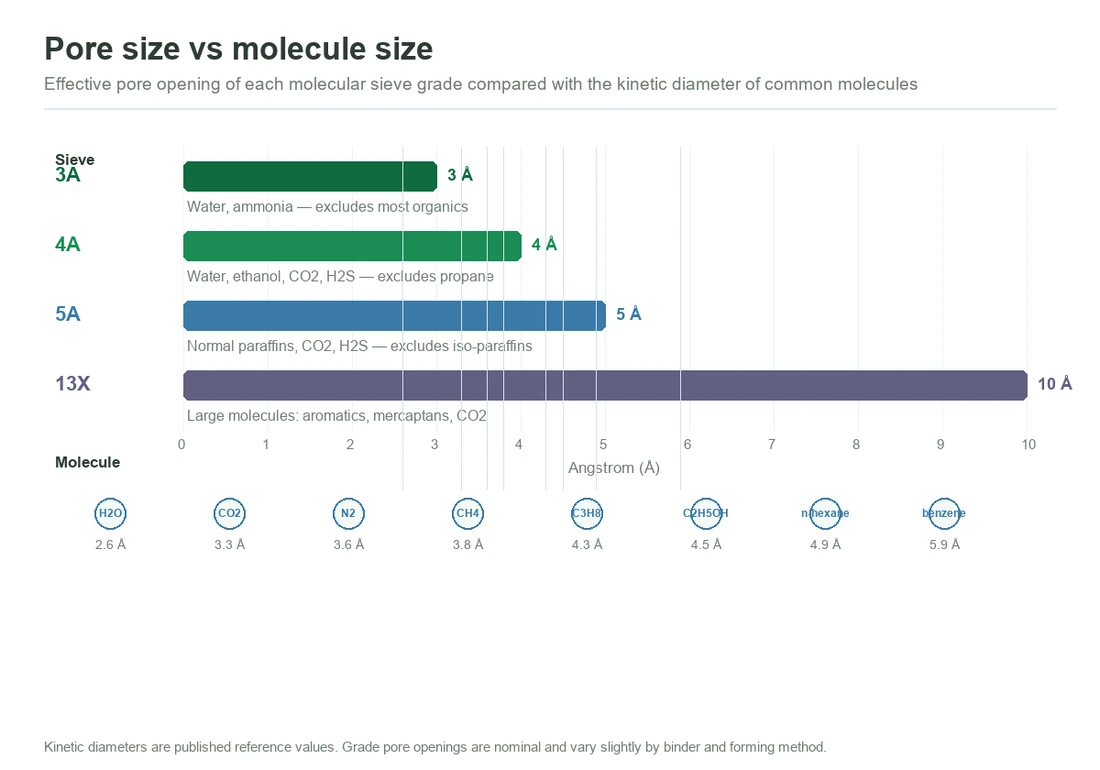
4A is the standard choice for natural gas and air dehydration. Use 3A when you must keep larger molecules out of the pores (ethanol, unsaturated hydrocarbons, insulating glass units), 13X when CO2 or H2S has to be removed as well, and 5A for normal-paraffin separation.
3A or 4A for insulating glass?
3A. A 4A pore also adsorbs nitrogen from the sealed unit, which can pull the panes inward and cause deflection. 3A keeps nitrogen out — that is why the insulating glass industry specifies it.
Beads or pellets?
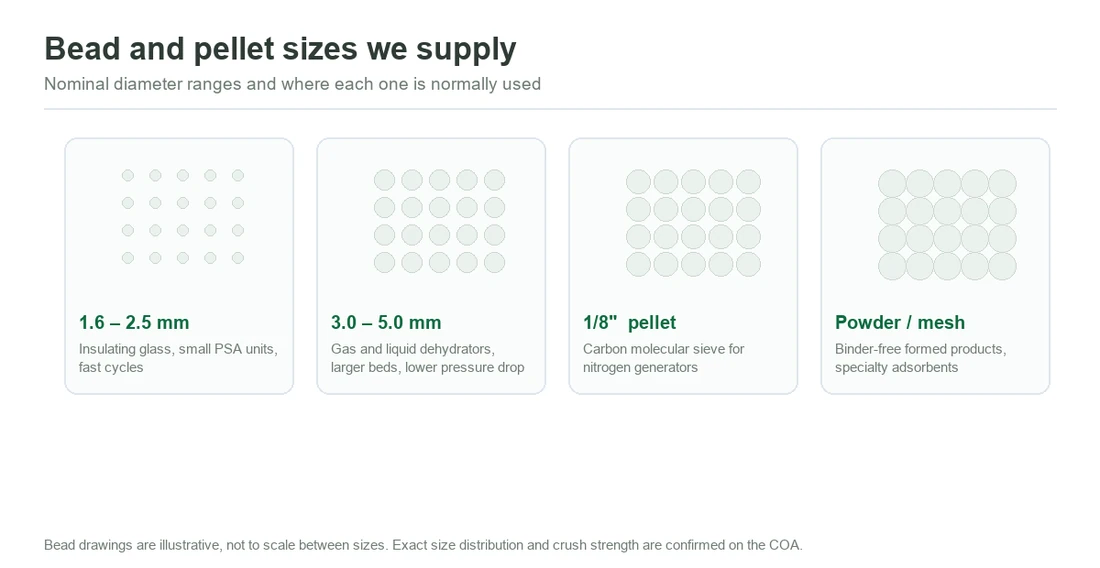
Beads give lower attrition and a more even bed for temperature-swing units; pellets (extrudates) are used where pressure drop or mechanical strength drives the choice. Both are available in 1.6–2.5 mm and 3–5 mm.
What particle size should I order?
1.6–2.5 mm for gas-phase service (shorter mass-transfer zone, higher pressure drop); 3–5 mm for liquid service and larger vessels. Check your vessel pressure-drop limit before you fix the size.
Can I get a grade between your standard ones?
Yes. Particle size, bulk density target, adsorption target and packing can all be adjusted — see Custom & OEM.
How do I know when the bed is spent?
Track outlet dew point or outlet water content against your design limit, not the running hours. Regeneration is normally 200–350 °C with dry purge gas; the exact window depends on the grade and the duty.
Sizes, packing and shipping
What is your MOQ?
1,000 kg per grade per shipment for export orders. Evaluation samples of 1–5 kg go by courier for qualified industrial enquiries.
How is it packed?
25 kg bags, 130–150 kg steel drums or 750–1,000 kg big bags (FIBC), all with an inner moisture-barrier liner. Palletised, stretch-wrapped and marked with grade, lot number, net weight and production date.
What is the lead time?
10–15 working days after deposit for standard grades, ex-works. Custom sizes and peak season run longer — the date on your quotation is the one that counts.
Which ports do you ship from?
Qingdao and Shanghai for FCL and LCL. We quote EXW, FOB, CFR and CIF; tell us your destination port and we price the freight with the material.
Can you ship under our own label?
Yes. Bag print, drum marking and private-label documentation are part of the OEM service.
Documents, quality and compliance
Do you issue a certificate of analysis?
Yes — one per batch, with the measured values of that lot: static water adsorption, bulk density, crush strength, attrition, size distribution and moisture at packing.
Are the numbers on this site guaranteed?
No. They are typical values from our production range and from the national standard test methods. The values that govern your order are the ones on the batch COA, and we state the test method next to each of them.
Can you support REACH or other import compliance?
We do not claim a REACH registration number. Tell us your import requirement and your tonnage band and we will confirm in writing, before you order, exactly what we can support. The SDS follows the EU 2020/878 format.
Can I inspect before shipment?
Yes. Your own team or a third party — SGS, Bureau Veritas, Intertek — can inspect at the plant before loading. Normally at the buyer’s cost unless agreed otherwise in the contract.
What if a batch does not meet specification?
Each lot is traceable by lot number and we keep a retained sample. Send us the COA and your test report; where the deviation is ours we replace or credit.
Ordering, payment and samples
What payment terms do you work on?
T/T with a deposit and the balance before shipment, or L/C at sight for larger orders. The exact split and the documents required are stated on your quotation.
How do I get a sample?
Email the grade, size and the duty. We send 1–5 kg by courier; the sample is free for qualified industrial enquiries and you cover the freight.
Do you sign an NDA?
Yes, for custom formulations, private-label work and any test data you share with us.
Can you quote against a competitor’s specification?
Yes. Send their data sheet and we will tell you, in writing, which lines we can match exactly, which we can only approach, and which we cannot meet — before you spend time on a trial.
How long does a quotation take?
One working day for standard grades with grade, quantity and destination port. Custom grades take longer because feasibility has to be confirmed with production first.
Nothing on this page is a binding specification. Specifications are agreed in writing per order and evidenced by the batch certificate of analysis.
Still deciding which grade?
Send the duty — gas or liquid, temperature, pressure, what has to be removed and to what level — and we will come back with a grade, a size and a price within one working day.