
Carbon Molecular Sieve for PSA Nitrogen Generation
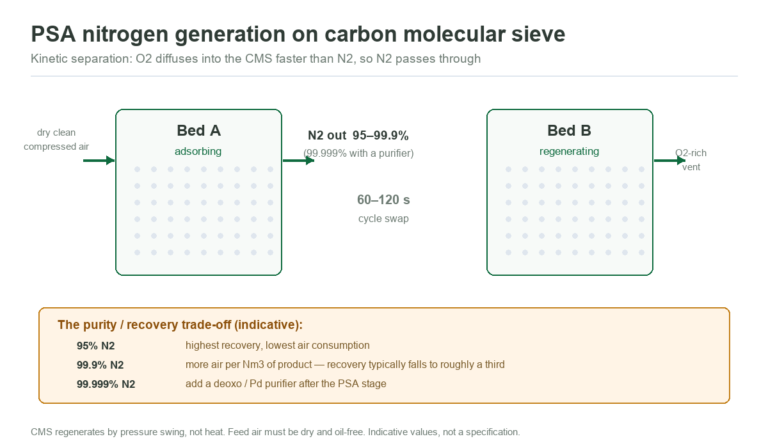
How carbon molecular sieve separates nitrogen by adsorption speed, what purity costs in compressed air, when to replace a fill, and the feed-air rules that decide CMS life.


Zeolite & Carbon Molecular Sieves for Industrial Drying and Gas Separation
Zeolite & Carbon Molecular Sieves for Industrial Drying and Gas Separation

How carbon molecular sieve separates nitrogen by adsorption speed, what purity costs in compressed air, when to replace a fill, and the feed-air rules that decide CMS life.
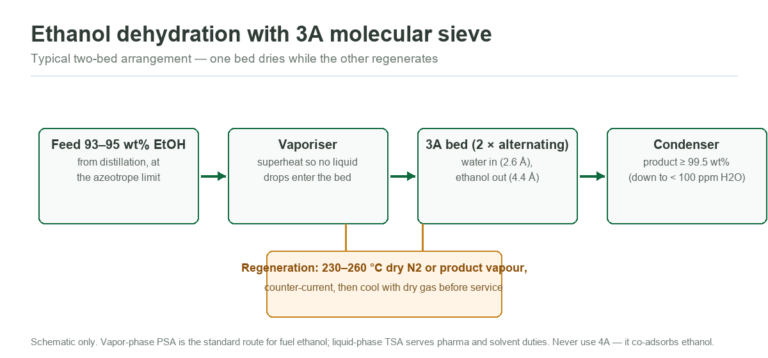
Why 3A is the only sieve that dries ethanol without losing product, the two process routes (vapor PSA and liquid TSA), the specification lines that matter, and the regeneration window that protects bed life.
Biomethane plants ask the sieve to remove CO2, water or both. Which duty you give it decides the grade, the cycle and whether the bed survives — and siloxanes decide everything.
Short cycles, rising dew point and higher pressure drop have different causes and different fixes. A field guide to diagnosing a molecular sieve bed before you buy a replacement.
Synthetic zeolite molecular sieve is classified under HS 2842.10, not the catch-all 3824.99. The difference changes duty, documentary requirements and how quickly your shipment clears.
Bead size is a pressure-drop decision and a mass-transfer decision at the same time, and the two pull in opposite directions. How to pick a size that holds capacity without choking the bed.
The three desiccants are not interchangeable. Pore size, achievable dew point, CO2 co-adsorption and regeneration temperature decide which one your dryer actually needs — and where a layered bed beats any single material.
Solvent-free synthesis and microwave routes moved toward production share in 2026. What is real in molecular sieve technology, and what it changes.
China exports about 197,000 tonnes of molecular sieve a year. A buyer's checklist covering specification, documents, packaging and inspection.
Industrial gas separation grew fastest among molecular sieve applications in 2026 while traditional drying matured. Where demand is heading next.