



Molecular sieve is not a commodity with a single published price. The number you pay depends on grade, bead size, binder content, quantity, packaging and Incoterms — and in 2026 it also depends on when you lock it in. This article sets out where public price indicators stood in late 2026 and how to turn them into a realistic budget.
Where public price indicators stood in late 2026
| Indicator | Late 2026 level | Basis |
|---|---|---|
| China molecular sieve index price | RMB 8,300/t | Index quoted 18 Sep 2026; 30-day range RMB 8,300–8,500 |
| China A-type listings (3A / 4A / 5A) | RMB 8,300–8,500/t | Henan market listings, Oct 2026 |
| China 13X listings | around RMB 11,500/t | Henan market listings, Oct 2026 |
| China export listings, zeolite grades | USD 1,300–2,200/t FOB | B2B platform listings, 1 t MOQ, 2026 |
| China export listings, carbon molecular sieve | USD 6,000–8,000/t FOB | B2B platform listings, 1 t MOQ, 2026 |
Two things stand out. First, the China domestic index was unusually flat through the second half of 2026 — the published 30-day range narrowed to RMB 8,300–8,500/t, which points to a balanced spot market rather than a shortage. Second, the gap between A-type and 13X listings is wide: around 35% on published numbers.
Why 13X costs more than 3A or 4A
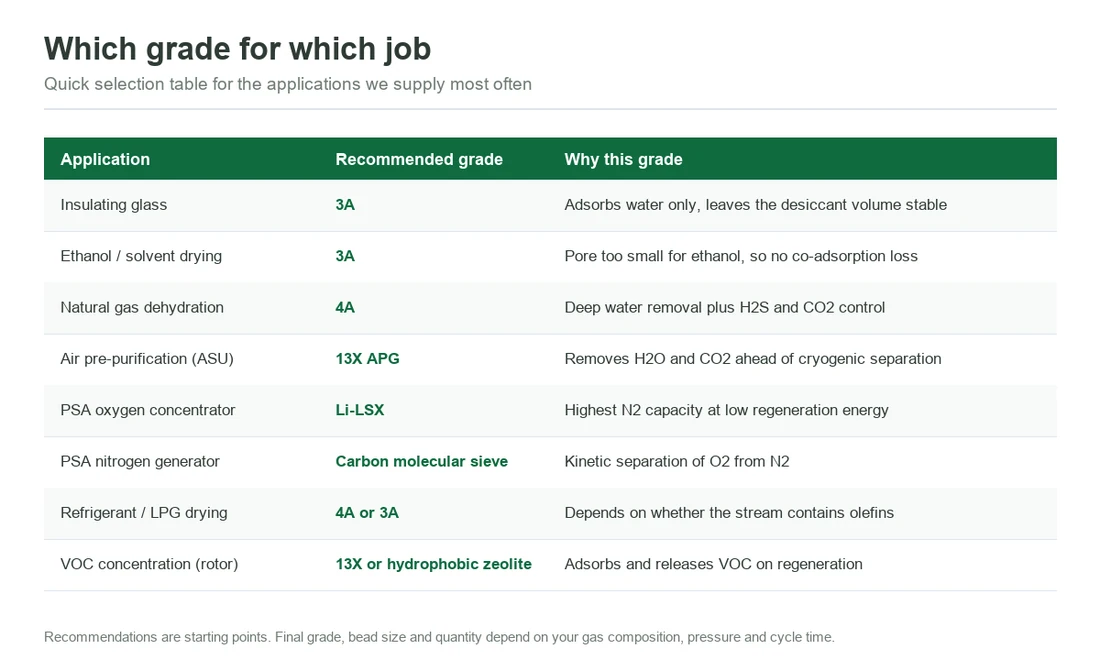
13X has a larger pore opening (about 10 angstrom against 3 and 4 angstrom for 3A and 4A), a higher adsorption capacity for larger molecules, and a synthesis route that uses more silica relative to alumina. It also has a higher equilibrium water capacity, which is exactly why it is specified for gas purification and air separation — and why it is not worth paying for if all you need is dehydration.
| Grade | Nominal pore | Typical use | Cost position |
|---|---|---|---|
| 3A | 3 Å | Dehydration of unsaturated streams, insulating glass, refrigeration | Base |
| 4A | 4 Å | General drying, static desiccation, detergent builder | Base |
| 5A | 5 Å | Normal paraffin separation, PSA hydrogen and oxygen | Modest premium |
| 13X | 10 Å | Air separation, CO2 removal, VOC and mercaptan capture | Highest of the four |
| 13X APG | 10 Å | Air purification before cryogenic separation | Premium, application-qualified |
| Li-LSX | about 7.4 Å | High-purity PSA/VPSA oxygen, medical concentrators | Premium, lithium-bearing |
| Carbon molecular sieve | kinetic separation | PSA nitrogen generation | Separate cost structure |
Li-LSX and carbon molecular sieve sit outside the zeolite price band entirely. Li-LSX carries lithium in the exchange step, so its cost tracks lithium salt pricing, not the sodium aluminosilicate chain that sets 3A and 4A costs.
What was moving prices in 2026
Raw materials account for more than half of molecular sieve cost. The main inputs are sodium aluminate, sodium silicate, caustic soda and — for lithium grades — lithium salt. Through 2025 those inputs sat at low levels: chlor-alkali and basic chemical capacity was ample, demand from construction and traditional metallurgy was weak, and a wave of new lithium supply pushed lithium salt prices down to a floor in the second half of the year.
That changed in the first half of 2026. Energy-saving and carbon-reduction policies tightened supply-side constraints on high-energy-consuming sectors including chlor-alkali, and some chemical producers cut output. Published tracking shows caustic soda, sodium silicate and sodium aluminate prices rebounding by roughly 5–10% over the first half of 2026, with lithium salt prices rising as well after the 2025 shake-out. The effect on finished molecular sieve was muted — the domestic index stayed flat — but it compresses producer margins, and it is the reason forward pricing conversations started earlier in 2026 than in 2025.
How to read a molecular sieve quote
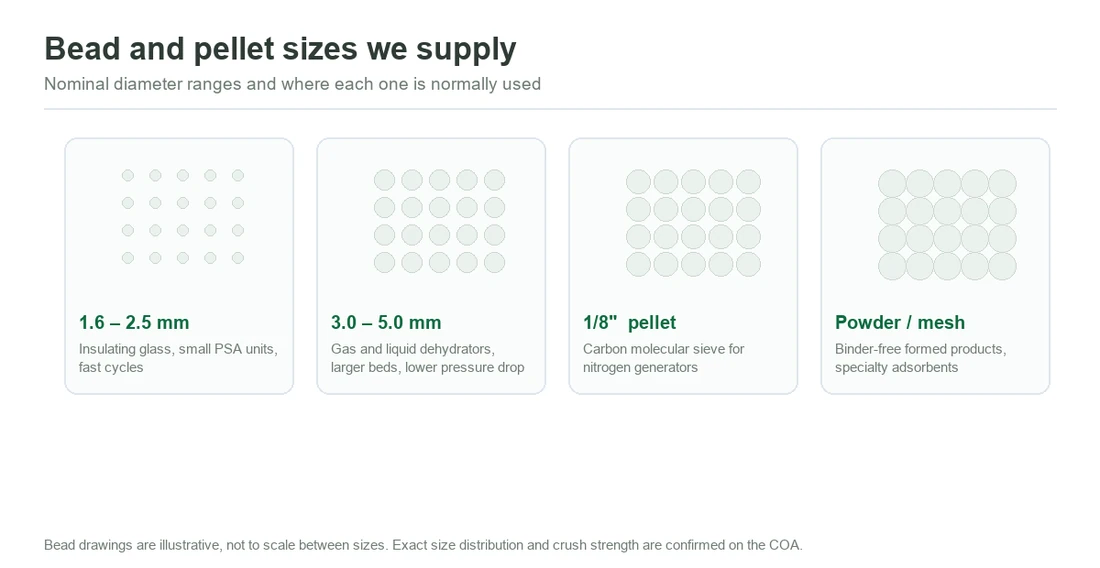
- Check the basis. A price per tonne is meaningless without the grade, bead size (for example 1.6–2.5 mm or 3–5 mm), bulk density and the quoted Incoterm. FOB and CIF can differ by more than 10% on the same product.
- Check whether the sieve is activated. Activated powder and formed bead are different products with different prices.
- Check what the equilibrium capacity is measured against. Static water adsorption at 25 °C / 75% RH and water capacity at 17.5 mmHg give very different numbers for the same material.
- Check the crush strength and attrition figures. These determine bed life far more than the headline price does.
- Check whether a batch COA is included. If a supplier will not commit to a certificate of analysis per batch, the low price usually means you are buying unspecified material.
- Watch for unit errors. Listings in the same feed sometimes quote the same product at RMB 1,200/t and RMB 11,500/t. One of those is wrong, and it is rarely the higher one.
When to lock in an order
Three situations justify fixing price and scheduling production ahead of need:
- You are substituting a grade. Qualification takes time. Run the trial on the material you intend to buy, not a sample from a different batch.
- You run a seasonal turnaround. Desiccant change-outs cluster, and lead times stretch when several plants schedule in the same window.
- You are buying a lithium grade. Li-LSX pricing follows lithium salt, which has been moving. A longer price-hold is worth asking for.
Our standard position is a minimum order of 1,000 kg and 10–15 days from confirmed specification to shipment for stocked grades, from a plant running 6,000 tonnes a year across seven grades. If your volume is steady, a framework agreement with a price-review clause is usually better for both sides than spot buying.
Related reading
- What Sets the Cost of Molecular Sieve
- Molecular Sieve Demand in 2026 by Application
- Importing Molecular Sieve from China: A Buyer’s Checklist
- Molecular Sieve Technology in 2026
Frequently asked questions
What is the price of molecular sieve per tonne in 2026?
Public Chinese index prices sat at RMB 8,300 per tonne in September 2026 with a 30-day range of RMB 8,300-8,500, while export listings for 3A, 4A, 5A and 13X ran from about USD 1,300 to USD 2,200 per tonne FOB at 1-tonne minimums. Your actual price depends on grade, bead size, quantity and Incoterms.
Why is 13X more expensive than 4A?
13X has a larger pore opening and a different silica-to-alumina ratio, and it delivers a higher equilibrium capacity for larger molecules. It is worth the premium for air separation, CO2 removal and VOC capture, but not if you only need to dry a gas or liquid stream, where 3A or 4A does the job for less.
Is molecular sieve pricing rising or falling?
Published Chinese index prices were flat in the second half of 2026, but the cost base moved up: caustic soda, sodium silicate and sodium aluminate rebounded about 5-10% in the first half of 2026 under energy and carbon policy pressure, and lithium salt rose after the 2025 shake-out. That compresses margins rather than showing up immediately in finished prices.
What minimum order quantity should I expect?
For formed molecular sieve beads, 1,000 kg is a typical minimum for export orders. Sample quantities of 0.5-1 kg are normally available for qualification testing before you commit to a production batch.
Does packaging change the price much?
Yes. A 25 kg bag, a 150 kg steel drum and a 1,000 kg big bag carry different handling, drum and palletising costs per tonne. For moisture-sensitive shipments the barrier packaging also matters more than the packaging cost difference, because a sieve that arrives pre-loaded with water has already lost part of its working capacity.
See also: how the grades compare, how we pack and ship, and request a sample for your specification.
Prices and market figures in this article are taken from publicly published third-party sources and are dated where known. They are industry reference points, not our quotation. We do not publish a price list — every quotation is built from grade, bead size, quantity, packaging and Incoterms. Ask us for a current quote for your specification.
[…] Molecular Sieve Price 2026: What Drives the Number […]