



Short answer: a PSA nitrogen generator runs on carbon molecular sieve (CMS), not on zeolite — zeolite 13X APG belongs upstream, in air pre-purification. Replacement quantity is sized from adsorber bed volume at a typical CMS bulk density of 630–700 kg/m³, with a 5–10% top-up; our minimum order is 1,000 kg per grade, standard lead time 10–15 working days, shipped FCA, EXW, FOB or CIF.
Most enquiries we receive from this sector come from two kinds of buyer: the OEM building generators, who needs consistent batches across a production run, and the maintenance contractor replacing beds in the field, often under time pressure because a customer’s generator is offline. They need different things from a supplier, and this page separates the two.
Which sieve actually sits in a nitrogen generator
Nitrogen is separated from air on carbon molecular sieve because CMS adsorbs oxygen preferentially through a kinetic mechanism: the oxygen molecule is smaller and diffuses into the carbon pore structure faster than nitrogen, so a short adsorption cycle produces a nitrogen-rich stream before the oxygen front breaks through. Zeolite does the opposite — it holds nitrogen and releases oxygen — which is why 13X and Li-LSX are used for oxygen generation, not nitrogen.
In a real generator the CMS bed is not alone. Upstream there is usually a 13X APG or activated alumina layer removing water and CO₂ before the air reaches the carbon bed, because carbon molecular sieve has little water capacity and a wet feed shortens CMS life. If you are specifying a new unit rather than replacing a bed, that layer arrangement is covered in our air pre-purification guide, and the cycle mechanics in CMS for PSA nitrogen generation.
Working out the replacement quantity
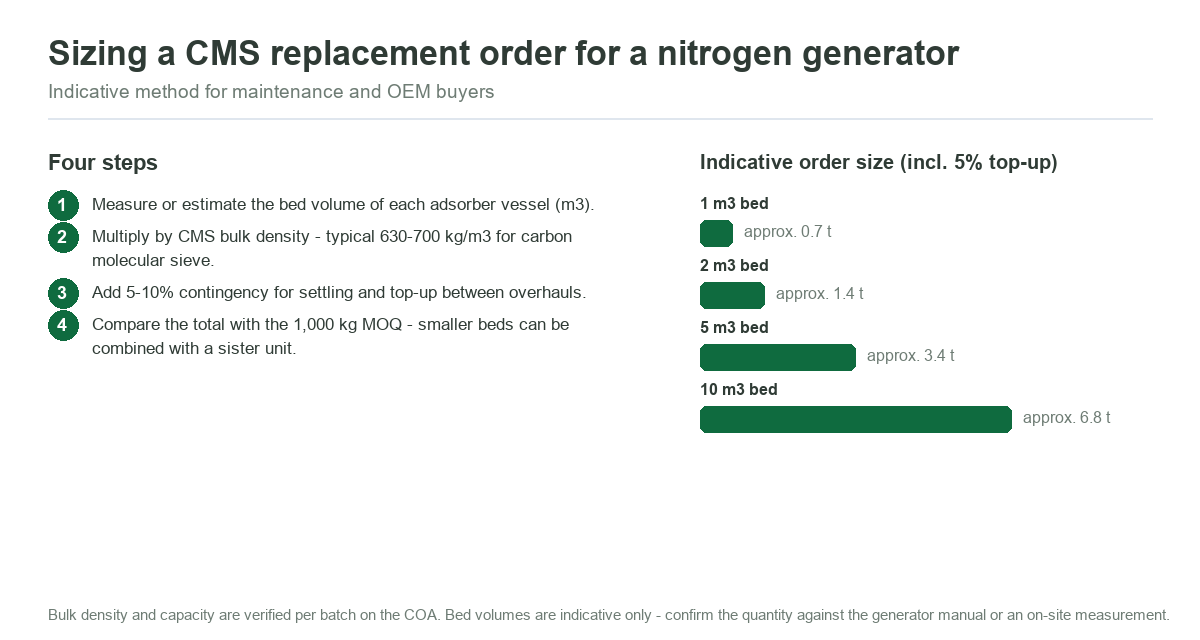
The arithmetic is simple, and it is the part buyers most often get wrong by ordering the nameplate bed weight instead of the actual fill. Four steps:
- Measure or estimate the internal volume of each adsorber vessel in cubic metres.
- Multiply by CMS bulk density — typically 630–700 kg/m³, confirmed on the batch COA.
- Add 5–10% for settling and top-up between overhauls.
- Compare the total with the 1,000 kg minimum order. Beds smaller than that are usually combined with a sister unit or with the pre-layer material in the same shipment.
Indicative order sizes: a 1 m³ bed works out at roughly 0.7 t, a 2 m³ bed at 1.4 t, a 5 m³ bed at 3.4 t and a 10 m³ bed at 6.8 t, including a 5% top-up. Treat these as planning figures — the quantity that binds is the one measured on site or taken from the generator manual.
When a nitrogen bed is actually due for replacement
CMS does not usually fail suddenly. The signs appear in this order: nitrogen purity drifts down at the same flow, recovery falls so the generator runs longer to fill the same receiver, and eventually the purity cannot be held at any reasonable flow. Before ordering a replacement, rule out the cheaper causes — a saturated pre-layer, a leaking valve, a short-circuited bed — because replacing CMS to fix a valve leak is an expensive way to learn the difference. Our deactivation and diagnosis guide walks through the checks in the order that costs least first.
Two mechanisms account for most premature CMS loss: water carry-over from a spent pre-layer, and oil aerosol from a compressor whose coalescing filter has been left in service too long. Both are upstream problems, which is why the pre-layer specification matters as much as the carbon itself.
Bulk terms for OEMs and maintenance contractors
The commercial terms are the same as any bulk order — 1,000 kg minimum per grade and size, FCA, EXW, FOB, CFR, CIF or DAP, 10–15 working days for standard grades — but the buying pattern differs:
- OEM production runs. Consistency between batches matters more than any single figure on a datasheet, because a generator validated on one batch has to behave the same way on the next. We keep the production record for each lot, traceable by lot number, so a question about a unit built eighteen months ago can be answered.
- Maintenance contractors. The constraint is usually time, not price: a generator is offline and the site wants it back. Stocked grades ship within days; if the size is not stocked, the honest answer is the production date, not an optimistic promise. Air freight is possible for urgent replacements and is quoted on request.
- Private label and OEM packing. Bags and drums can carry your branding and lot numbering; marking is confirmed in writing before the run starts.
Specification lines for a CMS order
Carbon molecular sieve is specified less by adsorption capacity than by the properties that set cycle performance and bed life. Put these on the enquiry:
| Parameter | Why the buyer checks it |
|---|---|
| Particle size and uniformity | Sets pressure drop and the sharpness of the adsorption front |
| Bulk density | Converts bed volume into the kilograms you must order |
| Crush strength | Resists breakdown during filling, cycling and transport |
| Attrition resistance | Controls dust generation and the life of downstream filters |
| N₂ capacity and O₂/N₂ selectivity | Determines recovery and the purity achievable at your flow |
| Moisture as shipped | A wet batch has already lost part of its working capacity |
Values on this site are typical for the class of material. Your binding figures are measured on your batch and printed on its certificate of analysis — see carbon molecular sieve for the grade range, or the bed sizing guide for the process side.
Delivery, packing and documents
CMS ships in the same packing as the zeolite range: 25 kg multi-wall bags with PE liner, 130–150 kg drums, or 750–1,000 kg FIBC big bags, palletised and stretch-wrapped. Because carbon molecular sieve loses capacity on exposure to humid air, the barrier seal matters as much as the bag strength. Every shipment carries the batch COA, a 16-section SDS, the packing list and the commercial invoice; a certificate of origin is issued on request. Full commercial terms are on the bulk supply page.
Frequently asked questions
Which molecular sieve is used in a nitrogen generator?
Carbon molecular sieve (CMS). It adsorbs oxygen faster than nitrogen through a kinetic diffusion mechanism, so a short PSA cycle produces a nitrogen-rich stream. Zeolite 13X APG is used upstream in the same generator, but for air pre-purification — removing water and CO₂ — not for nitrogen separation.
How much molecular sieve does a nitrogen generator need?
Multiply the adsorber bed volume in cubic metres by CMS bulk density, typically 630–700 kg/m³, then add 5–10% for settling and top-up. One cubic metre of bed works out at roughly 0.7 t; a 10 m³ bed at roughly 6.8 t.
What is the minimum order for a CMS replacement?
1,000 kg per grade and particle size. Smaller beds are usually combined with the pre-layer material or with a sister unit in the same shipment.
How do I know when to replace the carbon molecular sieve?
Purity drifts down at the same flow, recovery falls, and eventually the target purity cannot be held. Check the pre-layer, valves and bed for channelling before ordering CMS — a saturated pre-layer or a leaking valve produces the same symptoms at a fraction of the cost.
Do you supply CMS in bulk for OEM production?
Yes. Carbon molecular sieve is produced on a dedicated line and supplied in 25 kg bags, 150 kg drums or 1,000 kg big bags, with lot traceability so units built months apart can be checked against their production record.
What lead time applies to a CMS order?
10–15 working days for standard grades from order confirmation. If the size you need is not stocked, we state the production date rather than an optimistic figure; air freight is available for urgent replacements.
What documents are supplied with a CMS shipment?
Batch certificate of analysis with measured values, a safety data sheet in the 16-section EU 2020/878 format, packing list and commercial invoice. Certificate of origin and third-party inspection are available on request.
Can CMS be shipped with zeolite in the same container?
Yes. Mixed shipments are common — CMS for the carbon bed plus 13X APG or activated alumina for the pre-layer — provided each grade and size meets the 1,000 kg minimum, and the packing and marking are confirmed in writing before production.
Send these six lines and we confirm quantity, price and date. Request a replacement quotation.
- Generator model and adsorber bed volume
- Required nitrogen purity and flow
- Particle size currently in use
- Quantity needed and whether a pre-layer is included
- Destination port and Incoterm
- Whether the unit is offline (for expedited shipping)
Send those to our technical desk and you get a grade recommendation, a datasheet for the exact grade proposed, and a quotation with packaging and Incoterms stated — not a generic price list.
Figures marked as typical ranges are indicative values compiled from published supplier datasheets and standard adsorption-engineering references. They describe the class of material, not our specification and not a performance guarantee for your unit. Bed design must be confirmed against your own flow, pressure, temperature and dew-point target.