


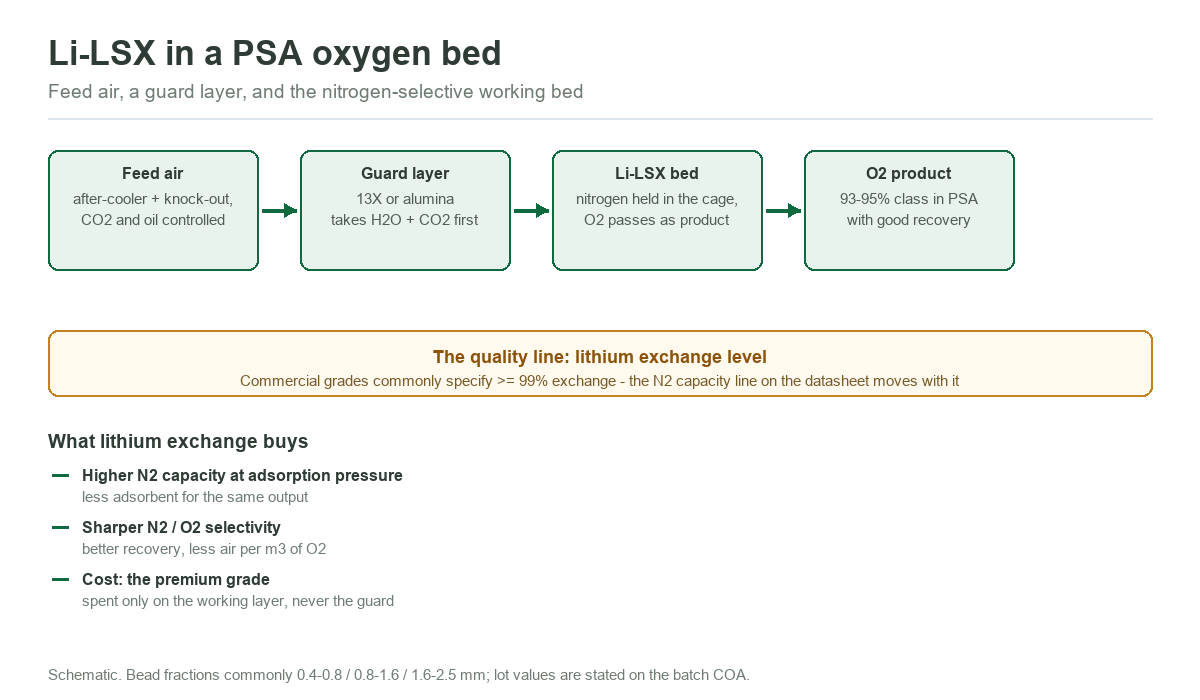
On-site oxygen is made by pushing air over a zeolite that grabs nitrogen and lets oxygen through. The zeolite is the machine: everything about the plant — recovery, air consumption, product purity at the oxygenanalyser — follows from the nitrogen capacity of that one bed. For serious PSA and VPSA oxygen duty, that zeolite is lithium-exchanged low-silicon X, Li-LSX.
This page is the selection brief we send to oxygen plant builders and medical concentrator assemblers: what the grade decides, what it does not, and what to demand on the certificate of analysis before a lot ships.
Why lithium exchange changes the game
A sodium X sieve (13X family) separates nitrogen from oxygen by a modest selectivity margin at best. Exchanging the sodium cations for lithium sharpens the electric field inside the cage, and nitrogen — with its quadrupole moment — binds far more strongly than oxygen does. Two consequences follow, and both show up on the datasheet:
- Higher nitrogen capacity at adsorption pressure — more N2 held per kilogram of sieve, so less adsorbent inventory for the same oxygen output.
- Sharper working selectivity — oxygen recovery rises at a given purity, so the compressor burns less air per cubic metre of product.
The exchange level is the quality line. Commercial Li-LSX grades are commonly specified at ≥99% lithium exchange, with premium lots higher; the nitrogen capacity line on the datasheet moves with it. A nominally Li-LSX grade with incomplete exchange quietly behaves like an expensive 13X.
Li-LSX and NaX side by side
| Li-LSX | NaX / 13X family | |
|---|---|---|
| N2 affinity at adsorption pressure | High — the design basis for oxygen duty | Moderate |
| Typical PSA product purity | Supports 93–95% O2 (medical 93–grade per pharmacopoeia limits) | Commonly lower for the same hardware |
| Oxygen recovery / air consumption | Better | Worse |
| Sensitivity to moisture and CO2 | High — needs a guard layer | Lower |
| Relative cost per kilogram | Higher | Lower |
All comparison statements are typical, grade-dependent behaviour; lot-specific values are stated on each batch certificate of analysis.
The guard layer is not optional
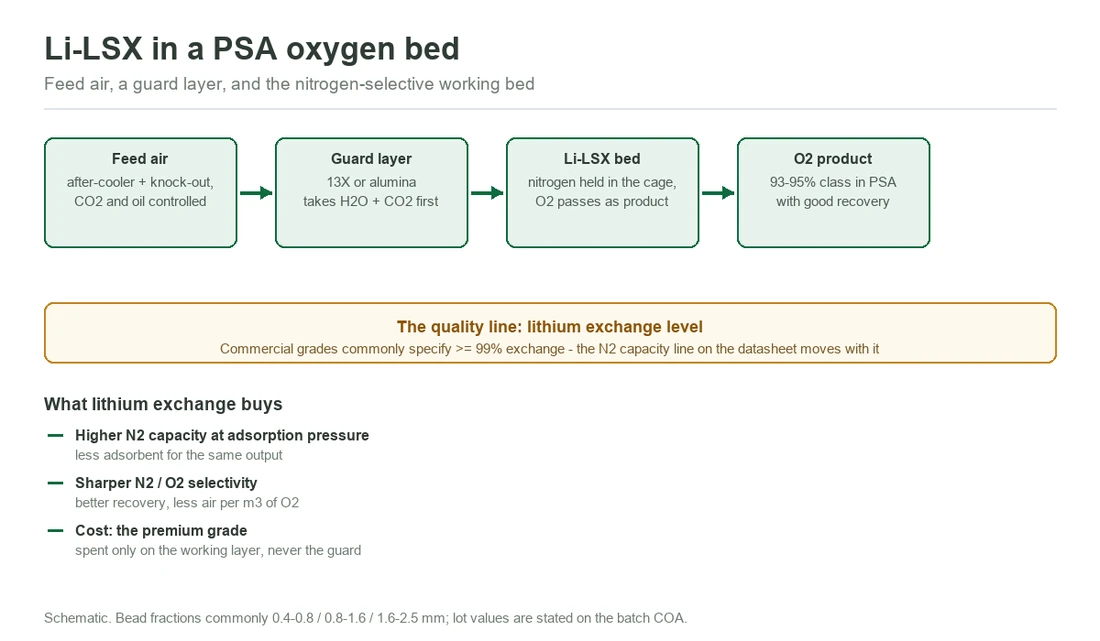
Lithium grades pay for their nitrogen capacity with a weakness: water and carbon dioxide attack the working capacity that you paid a premium for. A water slug or a CO2-loaded feed front permanently degrades the bed. Standard practice is a layered vessel:
- Bottom / inlet guard layer — 13X or activated alumina taking water and CO2 first, cheap to sacrifice.
- Working layer — Li-LSX doing the nitrogen duty only.
- Feed conditioning — after-cooler, water knock-out and drying to a low dew point before the air ever reaches the sieve.
Bead size and cycle time
Fast-cycle machines need small beads; deep industrial beds tolerate larger ones. Common supplied ranges are 0.4–0.8, 0.8–1.6 and 1.6–2.5 mm. As a rule of thumb, the shorter the cycle, the smaller the bead, because the mass-transfer zone has less time to develop — medical concentrators running seconds-scale cycles sit at the fine end, VPSA plants at the coarse end. State your cycle time and pressure ratio when you specify, not just the pore type.
The datasheet lines that matter
- N2 adsorption capacity (with the measurement pressure and temperature stated) — the headline number.
- Lithium exchange level — ≥99% is the usual commercial floor.
- Crush strength and attrition — the bed survives loading and years of pressure cycling only if these hold.
- Bulk density and bead sizing — they set how many kilograms fit the vessel you already drew.
- Water content as packed — the lot should arrive dry, and the COA should say so.
Figures marked as typical ranges are indicative values compiled from published supplier datasheets and standard adsorption-engineering references. They describe the class of material, not our specification and not a performance guarantee for your unit. Bed design must be confirmed against your own flow, pressure, temperature and dew-point target.
Specifying a Li-LSX bed? Send us the operating envelope and you get:
- Plant type: PSA medical concentrator, industrial PSA or VPSA
- Target purity and recovery, with cycle time and pressure ratio
- Feed condition: dew point, CO2 content, compressor oil risk
- Vessel dimensions, so we can size bead grade and layer split
Send those to our technical desk and you get a grade recommendation, a datasheet for the exact grade proposed, and a quotation with packaging and Incoterms stated — not a generic price list.
Related pages on this site
- Li-LSX molecular sieve product page
- Oxygen generation application overview
- 13X APG for guard and pre-purification layers
- Regeneration practice by sieve type
Frequently asked questions
What purity can Li-LSX reach in PSA?
Lithium grades support 93–95% oxygen in typical PSA hardware — the pharmacopoeia medical-oxygen region of 93% ±3 — at better recovery than sodium X grades in the same vessel.
Is Li-LSX better than 13X for oxygen?
For oxygen duty, yes: higher nitrogen capacity and sharper selectivity mean better recovery and less air per unit of product. 13X remains the right choice for guard layers, general drying and CO2 duty.
Why does Li-LSX need a guard layer?
Water and CO2 attack the working capacity of lithium grades. A 13X or alumina guard layer takes those contaminants first, protecting the expensive working bed.
What bead size suits a fast-cycle concentrator?
Fine fractions — commonly 0.4–0.8 or 0.8–1.6 mm — because short cycles leave little time for mass transfer. Larger beds on slower cycles use coarser fractions.
How do I verify a Li-LSX lot on arrival?
Check the COA lines: lithium exchange level (≥99% typical commercial floor), N2 adsorption capacity with its measurement conditions, crush strength,attrition and packed water content. Batch values, not brochure values.