



Every few weeks a process engineer asks us to quote “desiccant” for a dryer, and the enquiry does not say which one. That is the moment a project either gets the right material or spends the next five years regenerating the wrong one. Silica gel, activated alumina and molecular sieve all remove water. They do it at different dew points, at different energy costs, and with very different side reactions.
This page is the comparison we send back. It is written for the person who has to sign the datasheet, not for a chemistry exam.
The short answer
- Silica gel when you need bulk water removal cheaply and a −40 °C to −60 °C dew point is enough. It holds the most water per kilogram and regenerates at the lowest temperature.
- Activated alumina when the stream is wet, warm and slightly aggressive, and you want a hard bead that resists liquid water carry-over. Good intermediate dew point at moderate cost.
- Molecular sieve when the target dew point is below −70 °C, when the stream is hot, or when you must also remove CO2, H2S, mercaptans or small hydrocarbons that the other two ignore.
What each material actually does
The difference is not “quality”. It is pore geometry and surface polarity.
| Property | Silica gel | Activated alumina | Molecular sieve 3A / 4A |
|---|---|---|---|
| Nominal pore opening | ~2–3 nm (wide, non-uniform) | ~1–2 nm | 0.3 nm (3A) / 0.4 nm (4A) — fixed crystal aperture |
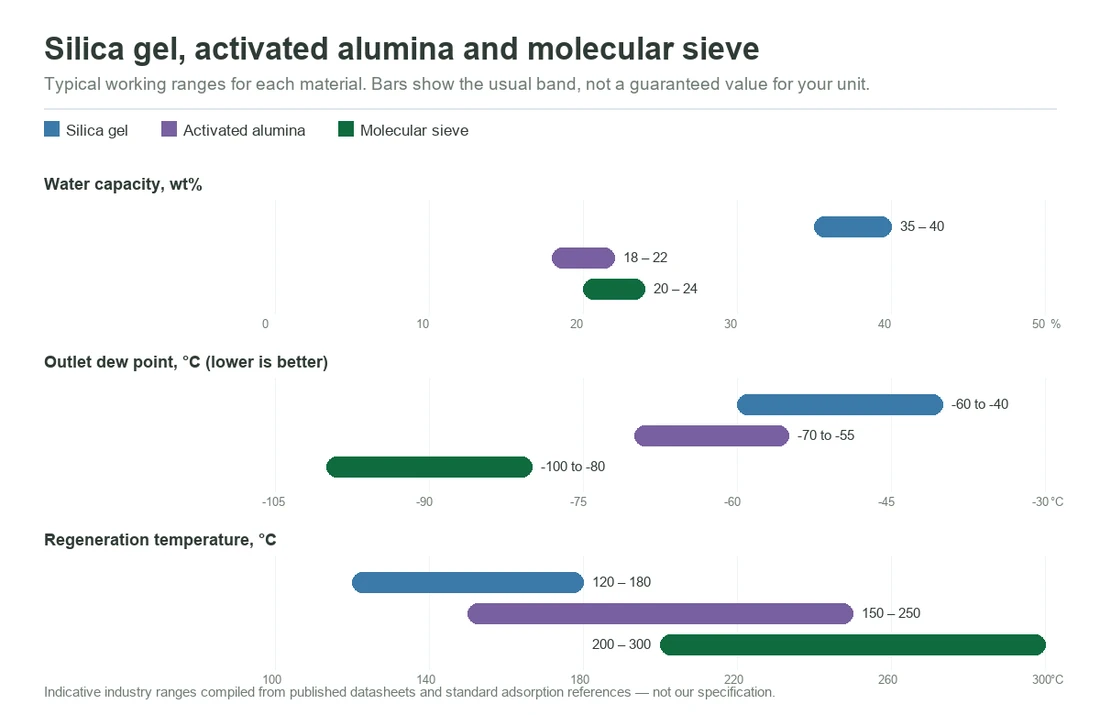
| Water capacity, typical | 35–40 wt% at high RH | 18–22 wt% | 20–22 wt% (3A), 22–24 wt% (4A) |
| Dew point achievable, typical | −40 to −60 °C | −55 to −70 °C | −80 °C and below; −100 °C with deep beds |
| Co-adsorbs CO2 | Weakly | Yes, and it is hard to remove | Yes on 4A/5A/13X; 3A does not |
| Regeneration temperature, typical | 120–180 °C | 150–250 °C | 200–300 °C |
| Behaviour with liquid water | Will crack and lose structure | Tolerates it better than the others | Tolerates it, but capacity drops if the bed is soaked repeatedly |
| Crush strength, typical | Low to moderate | High | Moderate to high (grade dependent) |
| Relative material cost | Lowest | Low | Highest of the three |
The single most useful line in that table is the pore size. Silica gel has a wide, irregular pore network: water goes in easily, and so does almost everything else. A molecular sieve has a crystal lattice with an aperture of a fixed size, so it excludes by molecular dimension. That is why 3A dries cracked gas without touching the ethylene, and why 4A in a CO2-containing stream will slowly fill up with CO2 as well as water.
Three questions that settle the choice
- What dew point must you hold at the outlet, continuously, not on day one? Above −60 °C, silica gel or alumina will do the job for less money. Below −70 °C, only a molecular sieve holds it — and it must be a sieve, because the residual water is at a partial pressure where the other two stop working.
- What else is in the gas? CO2 above a few hundred ppm, H2S, mercaptans, ammonia or methanol change the answer. On 4A and 13X these compete with water for sites; on 3A they largely pass through. If you need them gone, that is a second duty and it belongs in the specification, not in a footnote.
- Where does your regeneration heat come from, and what is it worth? A 250–300 °C regeneration is a real operating cost. If you have waste heat at 150 °C, silica gel or alumina may be the better economic choice even where a sieve would perform better.
Total cost, not price per tonne
Molecular sieve is the most expensive of the three per tonne, and on many units it is still the cheapest to own. Three effects usually outweigh the material price:
- Bed volume. A sieve can be run at a shorter cycle and a smaller bed for the same duty, which reduces vessel steel, footprint and the mass of material you have to buy in the first place.
- Life. Under clean, correctly regenerated conditions a sieve bed is commonly expected to run 5–10 years. Silica gel in a wet, cyclic duty is often changed far more frequently.
- Downstream protection. If your target is −80 °C, the cost of not reaching it is not the desiccant — it is the glycol unit, the cryogenic section or the catalyst downstream.
The reverse is also true. We have quoted replacements where a customer was buying molecular sieve for a duty that a −50 °C dew point satisfied, and paying twice for capacity they never used. If you are being sold a sieve for a job alumina could do, ask why.
Layered beds: the design most plants actually use
Where the load is heavy and the dew point target is deep, the sensible answer is often both materials in one vessel rather than an argument about which wins.
- Top layer — silica gel or activated alumina. Takes the bulk water load at low cost and protects the sieve from liquid carry-over.
- Bottom layer — molecular sieve. Polishes to the final dew point and handles the last, hardest fraction of water.
- Support and distribution. Ceramic balls graded by size, then a screen or support grid. This layer is not decorative: poor distribution is the most common reason a bed underperforms its datasheet.
Two rules of thumb worth stating, because they are violated constantly. Do not put the sieve on top of the alumina when water load is high — you will spend sieve capacity on water the alumina could have taken. And do not design the layer ratio by volume alone; design it by the water each layer will actually see per cycle.
Where molecular sieve is the wrong answer
- Very high inlet water load with a −40 °C target. You are paying for aperture you do not need, and the sieve will spend most of its life as an expensive bulk desiccant.
- Streams with heavy hydrocarbon condensation risk. Coke forms in the pores and regeneration will not clear it. Fix the upstream separation first.
- Anywhere the bed can be flooded and left wet. Repeated liquid water soaking degrades bead strength and eventually the crystal structure.
- CO2-rich streams needing water removal only. On 4A and 13X the CO2 will occupy capacity and may not fully desorb at your regeneration temperature. Use 3A, or accept a shorter cycle.
What to send us for a selection
A grade recommendation is only as good as the stream data behind it. Give us:
- Gas or liquid composition, including CO2, H2S and water content at the inlet
- Flow rate (Nm³/h or kg/h) and operating pressure and temperature
- Required outlet dew point or moisture specification, and how it is measured
- Vessel diameter, bed height available, and the pressure drop you can afford
- Regeneration method available: TSA, PSA, waste heat, dry gas — and the temperature
- Annual consumption or replacement frequency, so we can quote the right pack size
Send those to our technical desk and you get a grade recommendation, a datasheet for the exact grade proposed, and a quotation with packaging and Incoterms stated — not a generic price list.
Frequently asked questions
Can I replace silica gel with molecular sieve in the same vessel?
Physically yes, and it is done often. But a sieve needs a higher regeneration temperature, so the heater, the vessel insulation and the cycle time must be checked first. Replacing without re-checking regeneration is the most common cause of a sieve bed that never reaches its rated capacity.
Does molecular sieve remove CO2 as well as water?
4A, 5A and 13X do; 3A does not, because the 0.3 nm aperture excludes CO2. If both water and CO2 must be removed, expect a shorter cycle or a larger bed, and confirm the regeneration temperature is high enough to desorb the CO2 as well as the water.
Which desiccant gives the lowest dew point?
Molecular sieve, typically −80 °C and below, and lower with a deeper bed. Silica gel typically reaches −40 to −60 °C and activated alumina −55 to −70 °C. The figures depend on inlet conditions, bed depth and cycle time, not on the material alone.
Is activated alumina a cheaper substitute for molecular sieve?
Only where the dew point target allows it — above roughly −60 °C. Below that, alumina stops removing water effectively regardless of bed size, because the residual water partial pressure is too low for its isotherm.
Why is my molecular sieve bed not reaching its design dew point?
In order of frequency: incomplete regeneration, channeling from poor loading or a failed distributor, liquid water carry-over, and CO2 or hydrocarbon loading that the cycle was not designed for. Our deactivation guide walks through the diagnosis.
Can the three desiccants be mixed in one bed?
They should be layered, not mixed. Mixing destroys the point of layering, which is to let cheap material take the bulk load and expensive material polish the last fraction. Mixing also causes segregation during loading and uneven flow.
Related reading: grade comparison, regeneration and service life, industrial drying applications, and bead size selection.
Figures marked as typical ranges are indicative values compiled from published supplier datasheets and standard adsorption-engineering references. They describe the class of material, not our specification and not a performance guarantee for your unit. Bed design must be confirmed against your own flow, pressure, temperature and dew-point target.