



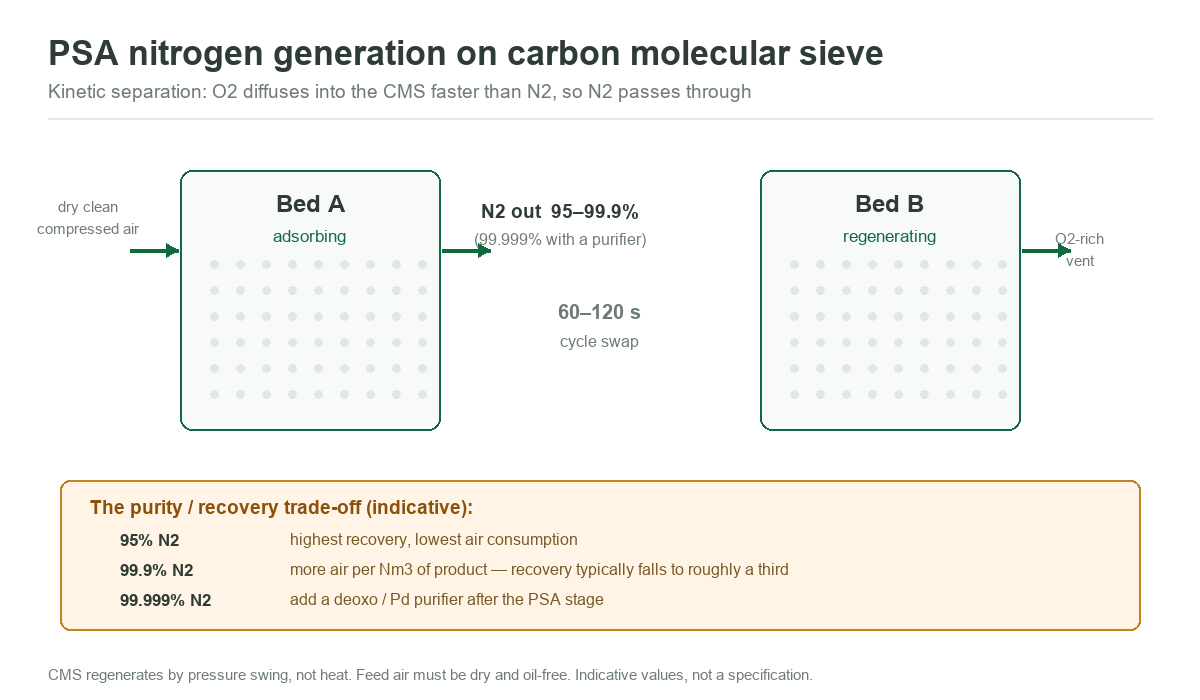
Every PSA nitrogen generator in the 95–99.9% purity band runs on carbon molecular sieve (CMS). Generator owners buy it once at commissioning and meet it again years later as a refill decision — usually after purity has started to slip. This page is the brief for both moments.
How CMS separates air — by speed, not size
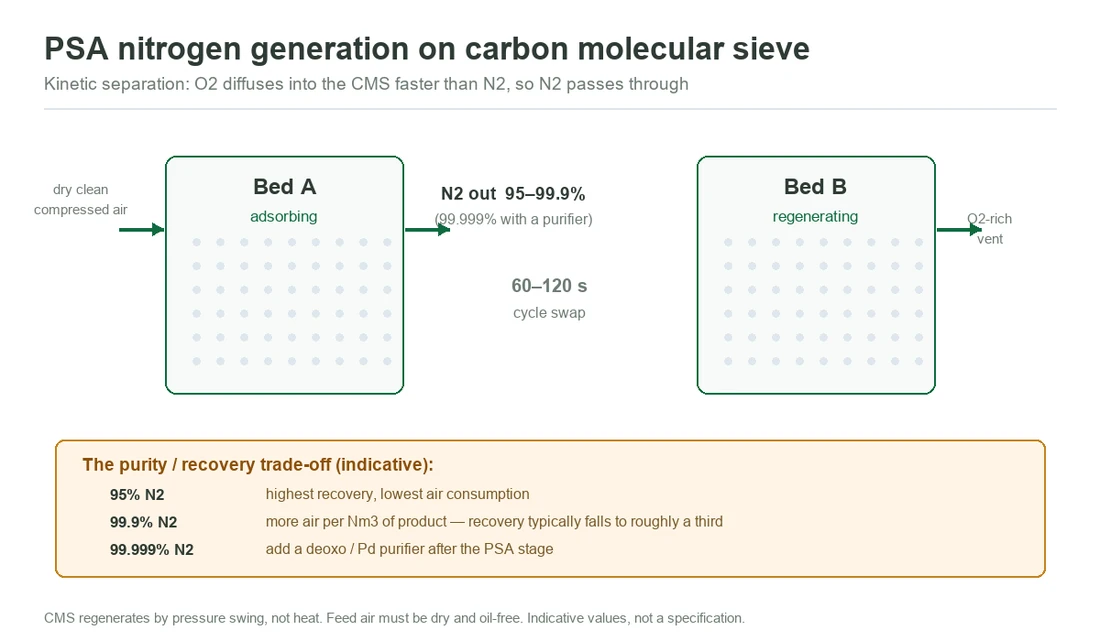
Unlike zeolite sieves, CMS does not mainly exclude by aperture. Oxygen diffuses into the carbon micropores noticeably faster than nitrogen, so in a short adsorption window the oxygen is captured and nitrogen passes through as product. Regeneration is a pressure swing — depressurise, purge, re-pressurise — with no thermal step at all.
- Two beds alternate on cycles of roughly 60–120 seconds: one adsorbs at pressure while the other vents and purges.
- Purity is a dial, not a constant. The same generator can run 95% or 99.9% — as purity rises, recovery falls and the machine consumes more compressed air per Nm³ of nitrogen delivered.
- Beyond ~99.9% a deoxo/palladium purifier after the PSA stage is the economic route to 99.999%.
What feed air quality does to CMS life
CMS is robust but it has two enemies, and both arrive through the feed air:
- Oil. Compressor oil aerosol coats the carbon pores and is effectively permanent. Coalescing filtration and an oil-free or well-maintained compressor are the single biggest CMS life factors.
- Water. Bulk moisture competes for pores and degrades kinetics. Feed the beds dry air — refrigeration drying is a minimum; many operators target a dew point of −20 °C or better at the CMS inlet.
With clean, dry feed, a CMS fill is commonly expected to serve 8–10 years. With oil-contaminated feed, refills inside two years are not unusual — and the refill will die the same way unless the upstream problem is fixed first.
Typical CMS properties
Ranges below are industry-typical figures commonly quoted for pelletised PSA-grade CMS. The binding numbers for any shipment are those on the batch certificate of analysis.
| Property | Typical range | Note |
|---|---|---|
| Form | Black cylindrical pellets | Commonly 1.0–1.7 mm diameter |
| Bulk density | ~0.62–0.68 g/mL | Converts generator bed volume into refill tonnage |
| Nitrogen purity, single PSA stage | 95–99.9% | Higher purities need a post-purifier |
| Cycle time | ~60–120 s | Set by the generator controller |
| Regeneration | Pressure swing only | Never thermal — heat in air oxidises CMS |
| Expected service life | 8–10 years, clean dry feed | Oil is the life-killer |
When does a fill actually need replacing?
- Purity drops at constant flow — the classic symptom. The controller compensates for a while (shorter cycles, more purge), then loses the race.
- Air consumption rises at constant purity — same physics seen from the compressor side; check it before blaming the compressor.
- Pellets arrive dusty or degraded on inspection — mechanical breakdown from fluidisation or water slugging, not normal ageing.
Before ordering a refill, have the operator record purity, flow and air/N2 ratio at the same conditions as commissioning data if it exists. A 10% drop tells a different story from a 40% drop, and so does a drop that appeared overnight (mechanical or water event) versus over years (normal kinetics fade).
Figures marked as typical ranges are indicative values compiled from published supplier datasheets and standard adsorption-engineering references. They describe the class of material, not our specification and not a performance guarantee for your unit. Bed design must be confirmed against your own flow, pressure, temperature and dew-point target.
For a refill quotation — or a CMS supply for a new generator build — send:
- Generator make/model and CMS fill volume (litres) if known
- Target purity and flow (Nm3/h), and hours per year of operation
- Feed air treatment: dryer type, dew point, oil lubricated or oil-free compressor
- Symptoms: purity trend, air consumption trend, any water or oil events
Send those to our technical desk and you get a grade recommendation, a datasheet for the exact grade proposed, and a quotation with packaging and Incoterms stated — not a generic price list.